How Arbitration Works in Construction
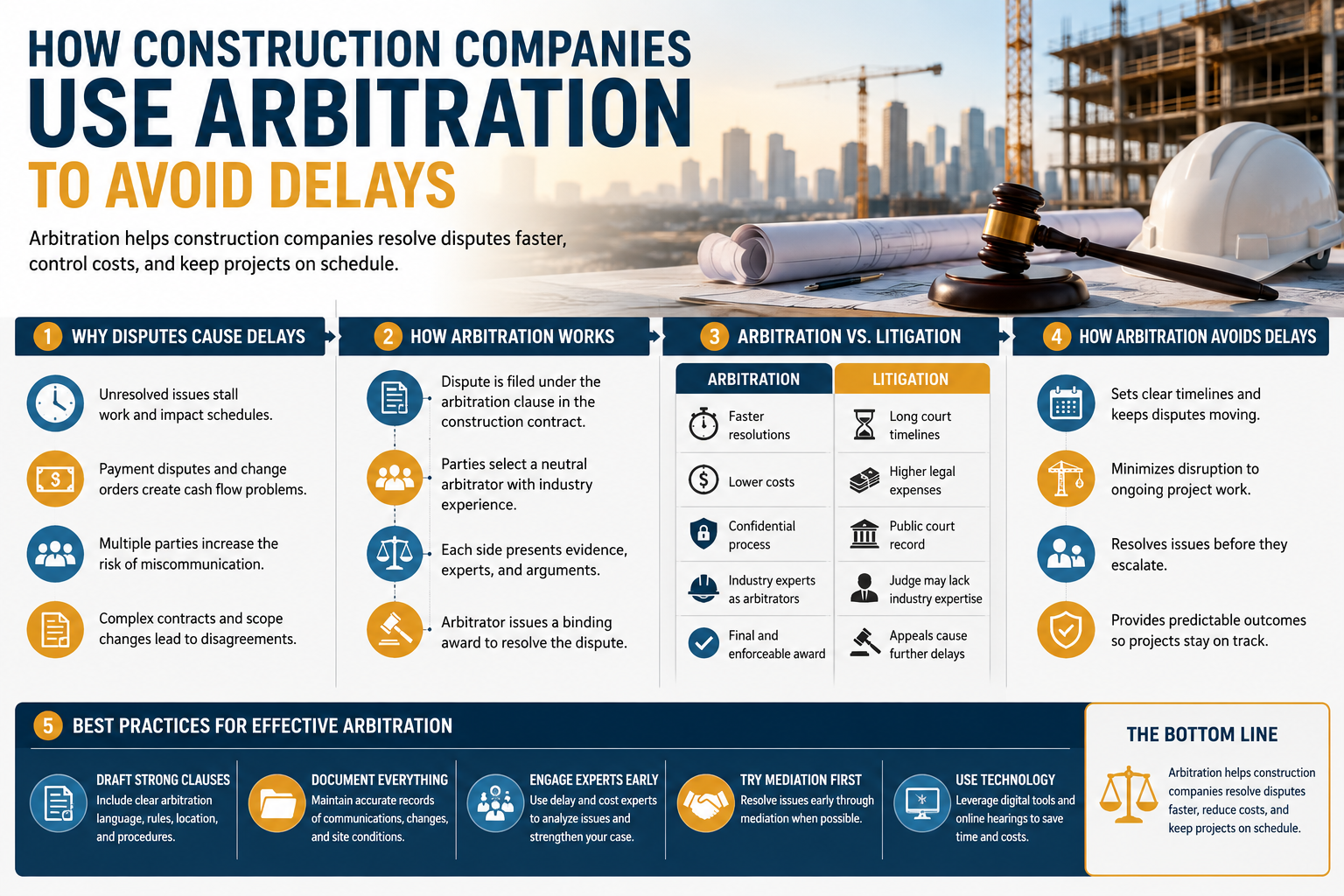
Construction arbitration is a private dispute resolution process where the parties submit their disagreement to a neutral arbitrator instead of a judge or jury. The arbitrator may be an attorney, retired judge, construction professional, engineer, architect, or other neutral with experience in construction law and industry practices. This industry knowledge can be especially helpful when the dispute involves technical evidence, scheduling issues, construction defects, or delay analysis.
The process usually starts with an arbitration clause in the construction contract. This clause explains that certain disputes must be resolved through arbitration rather than court litigation. It may also identify the arbitration rules, location, number of arbitrators, process for selecting the arbitrator, deadlines, confidentiality terms, and whether the arbitration award will be binding.
Once a dispute is filed, each side may submit claims, responses, documents, witness statements, expert reports, and other evidence. The arbitration process may include limited discovery, document requests, depositions, hearings, and written arguments. In many construction cases, expert evidence is important. Delay experts may analyze project schedules, critical path issues, and responsibility for lost time. Quantum experts may review added costs, damages, unpaid work, or financial impact.
After reviewing the evidence, the arbitrator issues an arbitration award. In binding arbitration, that award is generally final and enforceable. This gives parties a clearer endpoint than informal negotiation alone. The goal is not just to discuss the dispute, but to reach a decision that allows the parties to move forward.
Arbitration vs. Mediation in Construction Disputes
Mediation and arbitration are both forms of alternative dispute resolution, but they work differently. Mediation is a negotiation process guided by a neutral mediator. The mediator does not decide who wins. Instead, they help the parties communicate, understand their risks, and explore settlement options. Mediation can be useful when the parties want to preserve the business relationship or find a flexible solution.
Arbitration is more formal. The arbitrator acts as the decision-maker. Each side presents evidence and arguments, and the arbitrator issues a decision. Arbitration may feel similar to a private trial, but it is often more streamlined than court litigation. For construction companies, this can be valuable when negotiation has failed and the project needs a final answer.
Many construction contracts use both mediation and arbitration clauses. The contract may require the parties to try mediation first. If mediation does not resolve the dispute, the case may move to arbitration. This layered approach can help prevent unnecessary escalation. Smaller disputes may settle through mediation, while larger or more contested issues can be decided through arbitration.
Leaving mediation and arbitration clauses out of a construction contract can create uncertainty. If a dispute arises and there is no clear process, the parties may default to litigation. That can mean more time, more cost, and less control over the timeline. A clear dispute resolution clause gives everyone a better understanding of what happens when a conflict occurs.
How Arbitration Helps Construction Companies Avoid Delays
Arbitration helps construction companies avoid delays by giving disputes a defined path. Instead of allowing disagreements to sit unresolved or escalate into a lawsuit, arbitration creates deadlines, procedures, and a decision-making process. This structure can prevent disputes from freezing progress on the job.
Speed is one of the main advantages. Arbitration can often be scheduled more quickly than court proceedings. The parties may have more control over hearing dates, document exchange, and procedural rules. This is especially important when a project is ongoing and the dispute affects scheduling, payment, or the next phase of work.
Arbitration can also reduce disruption. A court case can pull owners, contractors, project managers, and witnesses away from daily operations for long periods. Arbitration can be more focused, with fewer procedural detours. The parties can often tailor the process to the size and complexity of the claim, which helps keep smaller disputes from becoming unnecessarily expensive.
Confidentiality is another benefit. Construction disputes may involve sensitive pricing, bid details, internal project communications, safety issues, subcontractor performance, or business relationships. Arbitration is usually more private than court litigation, which can reduce media attention and protect business reputations.
Arbitration also allows parties to choose an arbitrator with construction experience. This can save time because the decision-maker may already understand change orders, pay applications, lien issues, schedules, retainage, delay claims, construction defects, and industry standards. A knowledgeable arbitrator can focus the dispute more quickly than a court that must first learn the technical background.
Building Better Arbitration Clauses Into Construction Contracts
The value of arbitration depends heavily on the contract language. A vague arbitration clause can create confusion and delay. A strong clause should explain which disputes are covered, what rules apply, how the arbitrator is selected, where the arbitration will take place, and whether the award is binding. It should also address fees, timelines, confidentiality, emergency relief, and whether mediation is required first.
Construction companies should pay special attention to multi-party disputes. A project may involve owners, general contractors, subcontractors, suppliers, architects, and engineers. If the arbitration clause does not account for multiple parties, related disputes may end up split between different proceedings. That can create inconsistent results and more delays. A well-drafted clause can help consolidate related claims when appropriate.
The clause should also address documentation and evidence. Construction disputes often depend on records. Daily reports, photographs, schedules, requests for information, change orders, invoices, payment applications, emails, and inspection notes can all become important. The contract can help define how notices must be given, when claims must be raised, and what documentation is required.
Construction companies should also avoid treating arbitration as an afterthought during contract negotiations. The dispute resolution clause may not feel urgent when the project begins, but it becomes critical when problems arise. A clear arbitration clause can save time, reduce uncertainty, and help everyone understand the process before emotions and money are on the line.
Best Practices for Using Arbitration Without Slowing the Job
Arbitration works best when construction companies prepare before a dispute happens. The first step is strong documentation. Project managers should keep accurate daily logs, photos, meeting notes, schedule updates, change order records, payment communications, and written confirmations of important decisions. Good documentation helps the arbitrator understand what happened and reduces arguments over basic facts.
The second step is early issue identification. Construction companies should not wait until a dispute becomes unmanageable. If a delay, payment issue, scope change, or defect appears, the team should document it, communicate clearly, and follow the contract’s notice requirements. Early action can prevent small disagreements from becoming major claims.
The third step is using experts strategically. Delay analysis, risk assessments, engineering opinions, cost reviews, and expert testimony can be important in construction arbitration. However, experts should be used efficiently. The goal is to clarify the dispute, not bury the case in unnecessary reports. A well-prepared delay expert or quantum expert can help explain complex issues in a way that supports faster resolution.
Digital tools can also help. Construction software, online document sharing, video meeting apps, and organized project management systems make it easier to preserve evidence and participate in arbitration without slowing daily operations. Online arbitration or hybrid hearings may be useful when parties, witnesses, or experts are in different locations.
Finally, construction companies should remember that arbitration is not only about winning. It is about resolving disputes in a way that protects the project, controls costs, and keeps business moving. The best arbitration strategy is not reactive. It starts with the contract, continues through project documentation, and becomes a practical tool when disputes arise.
For contractors, owners, and subcontractors, delays can be expensive. Arbitration gives construction companies a way to handle disputes with more speed, privacy, industry knowledge, and finality than traditional litigation often allows. When used properly, it can help resolve construction issues before they turn into long court battles, keeping projects closer to schedule and businesses focused on the work ahead.