State vs. Federal Courts: Where Enforcement Happens
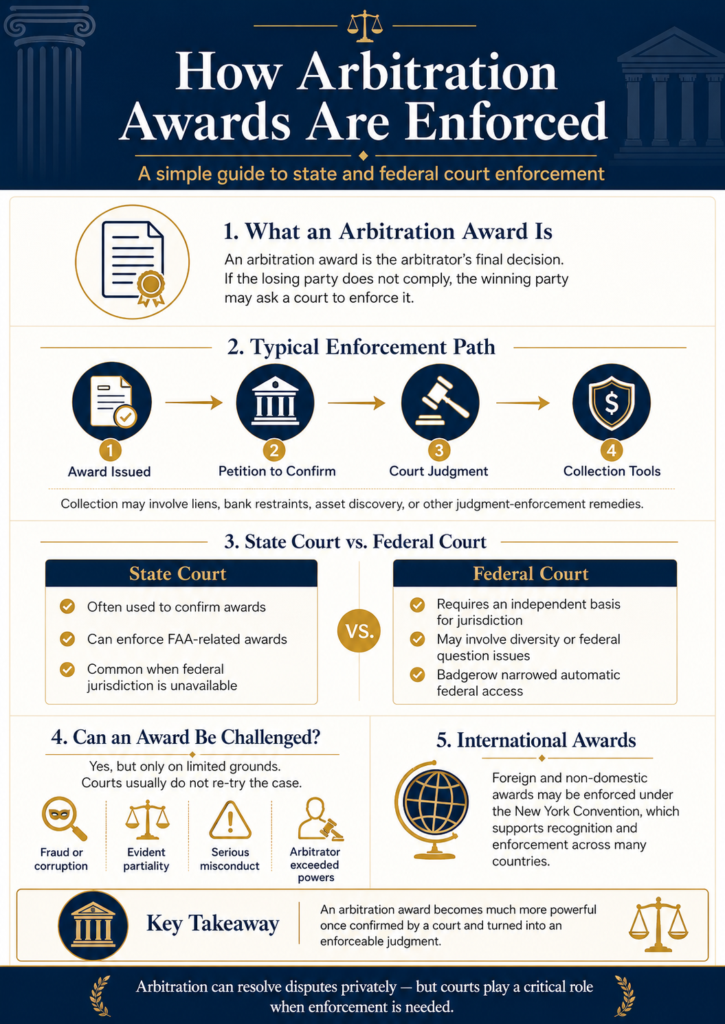
One of the most important questions after an arbitration award is where to enforce it. Many people assume that the Federal Arbitration Act automatically creates federal court jurisdiction for every arbitration award. That is not always true. The FAA provides important rules for arbitration agreements and award enforcement, but a party still needs an independent basis for federal jurisdiction in many domestic award cases.
Federal courts are courts of limited jurisdiction. A federal court may hear a case when there is federal question jurisdiction, diversity jurisdiction, or another valid jurisdictional basis. Federal question jurisdiction exists when the case arises under federal law. Diversity jurisdiction may apply when the parties are citizens of different states and the amount in controversy meets the legal threshold. Without a valid basis for federal jurisdiction, enforcement may need to happen in state court.
The U.S. Supreme Court addressed this issue in Badgerow v. Walters. The Court held that the “look-through” approach used for certain petitions to compel arbitration under Section 4 of the FAA does not apply to applications to confirm or vacate awards under Sections 9 and 10. In practical terms, a federal court generally cannot look through to the underlying dispute to create federal jurisdiction for confirming or vacating an award.
This makes state courts especially important. Even when the FAA applies, state courts often have authority to enforce arbitration agreements and awards. A party may be able to confirm an award in state court if federal jurisdiction is unavailable. For many business disputes, consumer matters, employment disputes, and contract claims, state court may be the proper or more practical place to confirm and enforce the award.
The arbitration agreement may also identify a specific court or location for confirmation. Some contracts state that judgment may be entered in a particular state court, federal district court, county, or jurisdiction. These clauses matter, but they do not always solve every jurisdictional issue. If a contract names a federal court but federal subject matter jurisdiction is missing, the party may still face procedural problems.
State law can also shape the enforcement process after confirmation. Once an arbitration award becomes a judgment, collection usually follows the rules of the court and state where enforcement is pursued. That may include rules for judgment liens, asset discovery, bank restraints, sheriff’s levies, turnover orders, or other collection procedures. For businesses, this is where practical enforcement strategy becomes just as important as legal confirmation.
Vacating, Modifying, or Challenging an Arbitration Award
The losing party may try to resist enforcement by asking a court to vacate, modify, or correct the arbitration award. These challenges are usually limited. Courts do not typically overturn an award because the arbitrator may have made a factual mistake or because one party believes the decision was unfair. The law favors finality, and the grounds for court intervention are narrow.
Under Section 10 of the Federal Arbitration Act, an award may be vacated in limited situations, such as where the award was procured by corruption, fraud, or undue means; where there was evident partiality or corruption by the arbitrator; where the arbitrator engaged in serious misconduct, such as refusing to hear material evidence; or where the arbitrator exceeded their powers. Section 11 addresses modification or correction in narrower circumstances, such as evident material miscalculations or mistakes in the form of the award.
These standards are intentionally demanding. A party challenging an award usually needs more than disappointment with the result. They must show a recognized legal ground for vacatur, modification, or correction. This is why arbitration can feel very different from litigation. In court, an appeal may allow broader review of legal errors. In arbitration, judicial review standards are more limited.
Timing also matters. Parties usually have strict deadlines to confirm, vacate, or modify an arbitration award. Missing those deadlines can create serious problems. A party that wants to challenge an award should act quickly, review the arbitration agreement, identify the governing rules, and determine which court has jurisdiction.
Challenges may also arise around the scope of the arbitration agreement. A party may argue that the arbitrator decided issues that were not submitted to arbitration, exceeded the arbitration clause, or awarded relief not allowed by the contract. Others may argue that the arbitration agreement was invalid, that notice was improper, or that the arbitral process was fundamentally unfair. Even then, courts often remain cautious about disturbing an award.
For award creditors, the best strategy is often preparation before enforcement becomes necessary. That may include preserving the arbitration agreement, keeping proof of service and notice, organizing the award and procedural record, confirming the debtor’s legal identity, and identifying potential assets early. If the losing party is likely to resist payment, asset recovery planning may begin before the court confirmation process is complete.
International Awards, the New York Convention, and Practical Collection
International arbitration awards involve additional rules. If an award was made outside the United States, or is considered non-domestic, recognition and enforcement may fall under the New York Convention. The Convention applies to the recognition and enforcement of arbitral awards made in a country different from the country where enforcement is sought, and it can also apply to awards not considered domestic in the enforcing country.
The New York Convention is important because it creates a widely recognized framework for enforcing foreign arbitral awards across contracting states. UNCITRAL explains that the Convention provides common legislative standards for court recognition and enforcement of foreign and non-domestic arbitral awards. In the United States, Chapter 2 of the Federal Arbitration Act implements the Convention, and Section 207 provides that a court shall confirm a Convention award unless it finds one of the Convention’s grounds for refusal or deferral.
This does not mean every international award is automatically collected. Recognition is only one part of the process. The award creditor may still need to locate assets, identify bank accounts, find receivables, pursue post-judgment discovery, or use state judgment-enforcement tools. If the debtor is a foreign company, sovereign entity, shell company, or business with complicated ownership, enforcement may involve additional issues such as the Foreign Sovereign Immunities Act, alter ego theories, veil-piercing, fraudulent transfer claims, or corporate formalities.
Practical enforcement often comes down to assets. A confirmed award is valuable, but collection depends on whether the debtor has reachable property. Businesses seeking enforcement may need to investigate where the debtor operates, banks, owns property, receives payments, or maintains business relationships. Asset tracing, subpoenas, judgment debtor examinations, and discovery into affiliated entities may become necessary.
The time required to enforce an award can vary. Some awards are paid soon after confirmation. Others require months of litigation, discovery, and collection efforts. The process may take longer if the debtor raises defenses, hides assets, moves funds, operates through related companies, or challenges jurisdiction. For international awards, translation, service, foreign law issues, and sovereign immunity questions may also affect timing.
For parties using Rapid Ruling or considering arbitration generally, the lesson is clear: arbitration does not end with the hearing. A strong arbitration strategy should also consider enforcement. That means drafting arbitration clauses carefully, identifying the proper court for confirmation, understanding state and federal jurisdiction, preserving the record, and thinking ahead about how an award would be collected if the losing party does not comply.
Arbitration can be a powerful way to resolve disputes faster than traditional litigation. But the value of an arbitration award depends on whether it can be enforced. State and federal courts provide the bridge between the arbitrator’s decision and real-world collection. When that process is handled correctly, an arbitration award can become more than a written decision. It can become an enforceable judgment with practical consequences.