
What Is Binding Arbitration?

July 8, 2026

Share Article:

Have Any Question?

Settling disputes with our online arbitration services is easy, fast, and affordable.

We look forward to answering your questions and helping you to reach conflict resolution with our online arbitration service.

Recent Posts
focused female lawyer working on laptop at workplace in office

Understanding Dispute Resolution Clauses in Contracts

A dispute resolution clause explains how parties will handle conflicts that arise from a contract. Instead of waiting until a disagreement begins, the parties decide in advance whether they will negotiate, mediate, arbitrate, litigate, or follow several of those

Read More »
Young man standing by flipchart and giving presentation over new business startup

Advantages and Disadvantages of Arbitration

Arbitration is a form of private dispute resolution used to resolve legal and business conflicts outside a formal court process. Instead of presenting the case to a judge or jury, the parties submit evidence, documents, witness testimony, and legal arguments to a

Read More »

New York Arbitration

New York arbitration gives businesses, individuals, legal practitioners, and in-house counsel a private alternative to traditional litigation. Instead of presenting a dispute to a judge or jury, parties submit the matter to a neutral arbitrator or panel of arbitrators. The dispute resolution process can involve
Read More »
Table of Contents

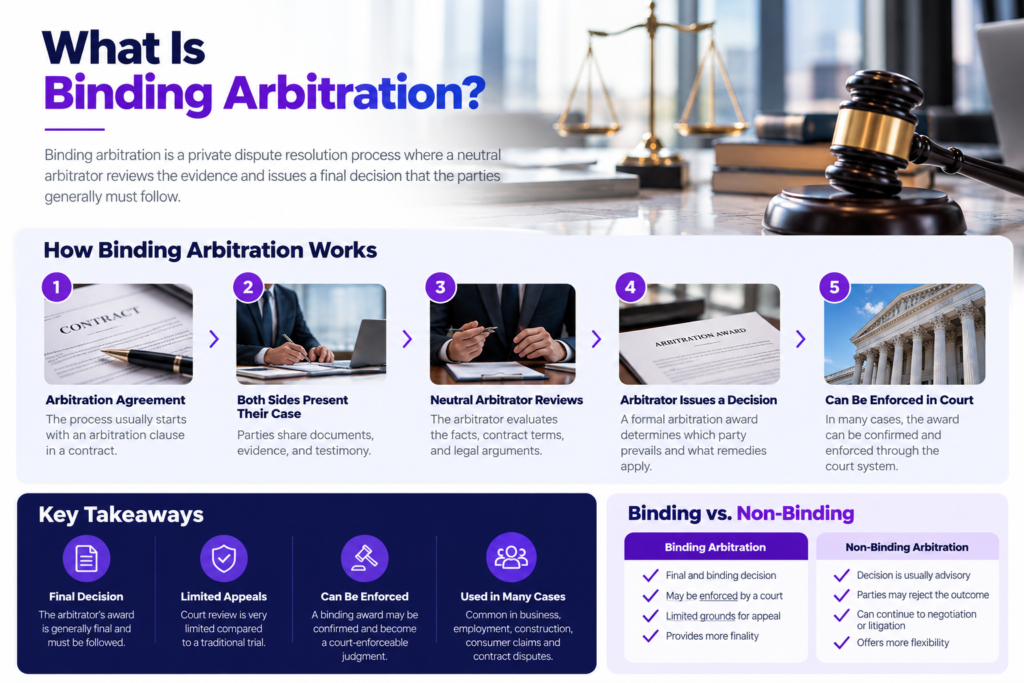
Binding arbitration is a private dispute resolution process in which two or more parties present a legal dispute to a neutral arbitrator instead of taking the matter through a traditional court trial. The arbitrator reviews evidence, testimony, contracts, and legal arguments before issuing a decision called an arbitration award. Because the process is binding, the parties generally must follow that decision. The award is not simply a suggestion or recommendation. In many cases, it can later be confirmed and enforced through the court system.

Binding arbitration is commonly used in contract disputes, business conflicts, employment contracts, construction matters, consumer claims, and other legal disputes where an arbitration clause applies. It is one form of alternative dispute resolution, or ADR, and is different from mediation because the arbitrator has authority to decide the dispute. The American Bar Association explains that binding arbitration generally results in a final decision with only limited opportunities for court review.

How Does Binding Arbitration Work?

The arbitration process usually begins with an arbitration agreement. This may appear as an arbitration clause inside a business agreement, employment contract, service contract, or other legal document. The clause may explain what disputes must go to arbitration, how an arbitrator or panel of arbitrators will be selected, what arbitration rules apply, and how costs will be handled. Under Section 2 of the Federal Arbitration Act, written arbitration agreements involving certain commercial transactions are generally enforceable, subject to legal defenses that apply to contracts.

Once arbitration begins, each side has an opportunity to explain its position. Depending on the arbitration rules, the parties may exchange information through discovery, submit documents, provide witness testimony, introduce other evidence, and make legal arguments. The process can resemble a simplified court proceeding, but it is usually conducted privately rather than before a judge and jury.

What Does the Arbitrator Decide?

The arbitrator evaluates the dispute based on the evidence, testimony, contract terms, applicable law, and arguments submitted by each side. Depending on the case, the arbitrator may decide whether a contract was breached, whether one party owes money, or whether another legal remedy is appropriate. The arbitrator must remain neutral and should disclose circumstances that could create a conflict of interest.

The available remedies depend on the arbitration agreement and governing law. They can include monetary damages and, in appropriate disputes, other remedies such as specific performance, declaratory relief, or injunctions. Because the award of the arbitrator may ultimately determine the parties’ legal obligations, selecting an appropriate neutral and understanding the arbitration rules are important parts of preparing for the proceeding.

What Is a Binding Arbitration Award?

A binding arbitration award is the formal decision issued after the arbitrator has considered the dispute. The award may identify which party prevailed, determine monetary damages, address contractual obligations, or provide other relief that falls within the arbitrator’s authority. Unlike a recommendation made during settlement negotiations, a binding arbitration award is intended to resolve the matters submitted to arbitration.

Federal law also provides a process for enforcing covered arbitration awards. Under Section 9 of the Federal Arbitration Act, a qualifying party may ask a court to confirm an arbitration award when the statutory requirements are satisfied. Once confirmed, the award can become a court-enforceable judgment, giving the prevailing party access to applicable enforcement tools if the other party does not voluntarily comply.

This finality is one of the main reasons businesses and individuals use binding arbitration. It can provide a definite resolution without requiring the parties to complete a full jury trial. However, finality also means that the losing party generally has fewer opportunities to challenge the outcome than it would after conventional litigation.

Can You Sue or Appeal After Binding Arbitration?

A party generally cannot restart the same dispute in court simply because it disagrees with the arbitrator’s decision. Binding arbitration provides much narrower review than a normal court appeal. Under Section 10 of the Federal Arbitration Act, covered awards may be vacated in limited situations involving issues such as fraud, corruption, evident partiality, certain misconduct, or an arbitrator exceeding the authority provided by the arbitration agreement.

Court proceedings can still occur after arbitration. For example, a party may ask a court to confirm or enforce an award, while another party may seek to modify or challenge it when legally permitted. These proceedings are different from receiving a completely new trial. The arbitration agreement, applicable law, and facts of the dispute determine what legal remedies remain available once the arbitrator issues a binding decision.

Binding vs. Non-Binding Arbitration

Binding and non-binding arbitration can look similar during the hearing but have very different consequences afterward. In both processes, the parties may present evidence, testimony, documents, and legal arguments to an arbitrator. The difference is whether the arbitrator’s decision is intended to be final. A binding arbitration award generally resolves the dispute and may become enforceable through the courts. A non-binding award is generally advisory unless it becomes binding under the rules governing that particular proceeding.

Non-binding arbitration may therefore be useful when parties want a neutral evaluation before continuing settlement negotiations, mediation, or litigation. Binding arbitration provides more finality, but the opportunity for appeals or further litigation is much more limited. Contract terms should clearly explain which process applies. Rapid Ruling provides a sample arbitration clause that illustrates how parties can address arbitration within an agreement before a dispute occurs.

Should You Agree to Binding Arbitration?

Whether binding arbitration makes sense depends on the type of dispute, the agreement, arbitration costs, available remedies, and the rights each party is giving up. Arbitration may provide a less formal alternative to courtroom litigation and may allow parties to choose an arbitrator with relevant legal or industry experience. It can be used for contract disputes, construction industry conflicts, real estate transactions, employment matters, landlord-tenant disputes, consumer claims, and other disputes when arbitration is permitted.

The tradeoff is that the arbitrator’s decision can be difficult to challenge. Before signing, opting into, or deciding whether to opt out of a binding arbitration provision, review the arbitration clause carefully. Look at how the arbitrator is selected, whether discovery is limited, who pays arbitration costs, what remedies are available, and whether the clause requires mandatory arbitration. Rapid Ruling provides online arbitration and dispute resolution services for parties seeking a structured alternative to traditional litigation.

Recent Posts

focused female lawyer working on laptop at workplace in office

Understanding Dispute Resolution Clauses in Contracts

A dispute resolution clause explains how parties will handle conflicts that arise from a contract. Instead of waiting until a disagreement begins, the parties decide in advance whether they will negotiate, mediate, arbitrate, litigate, or follow several of those

Read More »
Young man standing by flipchart and giving presentation over new business startup

Advantages and Disadvantages of Arbitration

Arbitration is a form of private dispute resolution used to resolve legal and business conflicts outside a formal court process. Instead of presenting the case to a judge or jury, the parties submit evidence, documents, witness testimony, and legal arguments to a

Read More »

New York Arbitration

New York arbitration gives businesses, individuals, legal practitioners, and in-house counsel a private alternative to traditional litigation. Instead of presenting a dispute to a judge or jury, parties submit the matter to a neutral arbitrator or panel of arbitrators. The dispute resolution process can involve

Read More »
Violet - Product design
Join our email list and file one claim free!*

*terms apply