

What is Family Law Arbitration?

June 26, 2026

Share Article:

Have Any Question?

Settling disputes with our online arbitration services is easy, fast, and affordable.

We look forward to answering your questions and helping you to reach conflict resolution with our online arbitration service.

Recent Posts

What is Family Law Arbitration?

Family law arbitration is a private dispute resolution process where family members present a disagreement to a neutral arbitrator. The arbitrator reviews evidence and applicable law before issuing an arbitration award. Unlike a mediator, an arbitrator decides disputed issues. The decision may be binding or non-binding

Read More »

What is a Civil Dispute?

Construction arbitration is a private dispute resolution process for disputes involving building, engineering, renovation, and infrastructure projects. Instead of presenting the case to a judge or jury, property owners, developers, contractors, subcontractors, design professionals, and suppliers submit

Read More »

What is Construction Arbitration?

Construction arbitration is a private dispute resolution process for disputes involving building, engineering, renovation, and infrastructure projects. Instead of presenting the case to a judge or jury, property owners, developers, contractors, subcontractors, design professionals, and suppliers submit

Read More »

What is Employment Arbitration?

Employment arbitration is an alternative dispute resolution process used to decide conflicts between employers and employees outside a traditional courtroom. The dispute is presented to a neutral arbitrator rather than a judge or jury. Each party can explain its position, submit documents, present

Read More »

What is Commercial Arbitration?

Commercial arbitration is an Alternative Dispute Resolution process for disagreements involving contracts, payments, services, partnerships, and other business matters. Instead of going through a court trial, the parties submit their positions to a neutral arbitrator or arbitral tribunal. The arbitrator
Read More »
Table of Contents

Family law arbitration is a private dispute resolution process where family members present a disagreement to a neutral arbitrator. The arbitrator reviews evidence and applicable law before issuing an arbitration award. Unlike a mediator, an arbitrator decides disputed issues. The decision may be binding or non-binding under state law and the arbitration agreement.

What Is Family Law Arbitration?

Family arbitration is an alternative to litigating every issue before a judge. Within legal limits, the parties can choose the arbitrator, format, schedule, and procedures. Hearings may occur in person or online, helping families address sensitive disputes without waiting for multiple court dates.

Family law arbitration is not identical across the United States. Some jurisdictions have specific statutes; others rely on general arbitration law, court rules, or family law decisions. Washington State, for example, has a Uniform Family Law Arbitration Act. Available issues, disclosures, court review, and enforceability therefore depend on where the case is filed.

The Uniform Law Commission developed a model act addressing child custody, child support, and domestic violence protections. States must adopt a model act before it becomes law. Parties should confirm which matters can be arbitrated and which decisions require court approval.

Family Law Matters That May Be Arbitrated

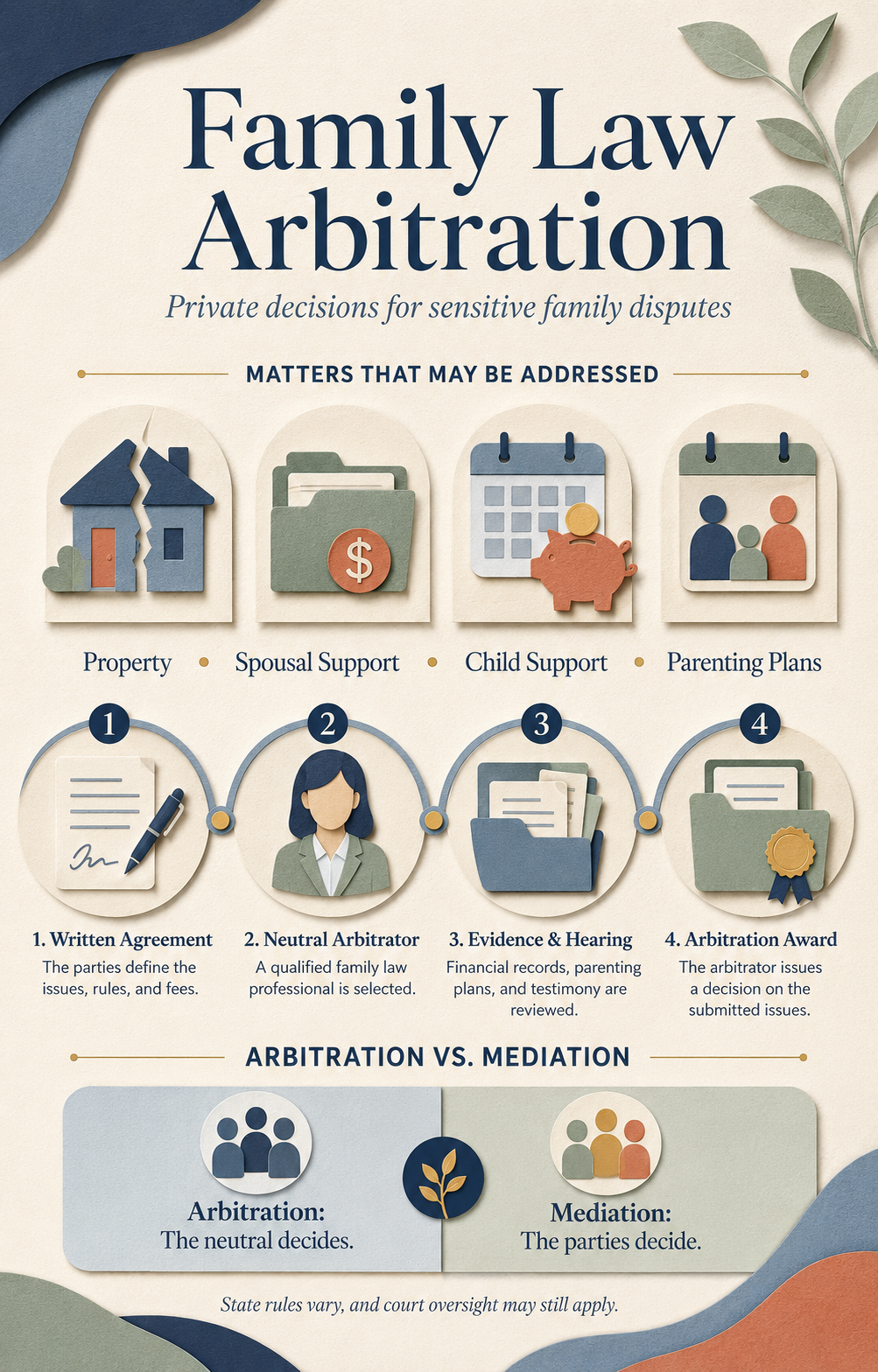
Family arbitration may address property division, debt allocation, spousal support, child support, parenting plans, custody, pensions, family-owned businesses, and interpretation of an existing settlement agreement. California court materials, for example, explain that ADR can help resolve property, support, paternity, custody, and parenting-plan disputes. The precise scope depends on the arbitration agreement and governing state law.

Financial disputes often involve tax returns, property records, retirement accounts, business valuations, and loan documents. A family law expert, accountant, appraiser, or pension professional may be needed when the assets are complex. Parties should exchange all required information before closing the record. An arbitrator cannot fairly divide property that was concealed or never valued.

Child-related matters receive additional court oversight because the children did not choose arbitration. An arbitrator may consider testimony, records, parenting schedules, evaluations, and other permitted evidence. Courts retain authority to protect a child’s best interests and may closely review custody or support awards. Temporary orders, emergencies, domestic violence, child abuse, and protection orders may also require immediate court involvement rather than private arbitration.

The Arbitration Process and Role of the Arbitrator

The process begins with a written arbitration agreement. It should identify the disputes being submitted, whether the decision is binding, the arbitrator-selection method, governing law, fees, confidentiality, hearing format, evidence rules, available remedies, and expected form of the award. Both parties should understand whether they are submitting all unresolved issues or only a narrow question, such as property value or the interpretation of a parenting provision.

After the arbitrator is selected, an initial conference establishes deadlines for documents, witness lists, expert reports, legal arguments, and the arbitration hearing. Each party then presents evidence and testimony. The arbitrator manages the proceeding, rules on procedural disputes, evaluates credibility, applies the controlling law, and issues a decision. An online divorce mediation and arbitration process can reduce travel and make document sharing easier when remote participation is appropriate.

The arbitrator decides issues, while a mediator helps the parties negotiate their own agreement. Riverside County’s court guidance explains that in private family mediation, the neutral mediator works with the parties to reach a voluntary resolution. Mediation may preserve more control and cooperation. Arbitration is useful when negotiations have stalled and the parties need a neutral professional to make a decision.

Preparation should include organizing financial disclosures, proposed parenting plans, communications, court orders, witness information, and a clear explanation of the requested outcome. Legal representation may be valuable even when the procedure is less formal than a trial. A family law attorney can explain state-specific rights, identify issues that cannot be delegated, prepare evidence, and review the possible effect of a binding arbitration award.

Benefits, Disadvantages, and Court Oversight

Family arbitration can offer privacy, flexible scheduling, streamlined procedures, and a decision-maker with family law experience. Parties may avoid repeated courtroom appearances and schedule an online or in-person hearing sooner than a full trial. They can also select an arbitrator familiar with complex property, support, or parenting issues. These benefits may reduce uncertainty, but arbitration is not automatically faster or less expensive in every case.

The disadvantages include arbitrator fees, attorney costs, expert expenses, limited appeal rights, and the risk of an unfavorable binding decision. Confidentiality may protect the hearing and exchanged documents, but it is not absolute. A court filing to confirm, modify, or challenge an award may place some information into the public record. Arbitration can also be inappropriate when intimidation, coercive control, undisclosed assets, domestic violence, or a serious power imbalance prevents meaningful participation.

Arbitration does not itself end a marriage. A court generally must enter the final divorce judgment and may review the arbitration award under the standards established by state law. Review of property or support decisions may be narrow, while decisions involving children may receive closer examination. A court may also intervene when the agreement was invalid, the arbitrator exceeded the granted authority, required procedures were denied, or the award conflicts with governing family law.

Choosing between arbitration and court depends on the family’s circumstances. Arbitration may work well when both parties can participate safely, financial information is available, and privacy or scheduling control matters. Court may be preferable when emergency relief, formal discovery, public enforcement, or stronger procedural protections are necessary. Mediation or collaborative practice may be better when the parties can still reach a voluntary agreement without assigning the decision to an arbitrator.

Frequently Asked Questions About Family Law Arbitration

What are the disadvantages of family arbitration?

Family arbitration can involve filing costs, arbitrator fees, attorneys, and expert witnesses. Appeal rights may be limited after a binding award, and private proceedings may provide less formal discovery than court. Arbitration may also be unsafe or unfair when domestic violence, intimidation, hidden assets, or unequal bargaining power affects participation. Court approval may still be required, especially for divorce judgments and decisions involving children.

Who usually wins in family arbitration?

Neither spouse or parent usually wins simply because of their role in the family. Results depend on state law, the arbitration agreement, financial disclosures, evidence, witness credibility, parenting facts, and the relief requested. Some awards divide different issues between the parties rather than naming one complete winner. No general win rate can predict how an arbitrator will decide a particular divorce, support, property, or custody dispute.

Is it better to use arbitration or court?

Arbitration may be better when the parties value privacy, flexibility, specialized experience, and a faster hearing schedule. Court may be better when someone needs emergency orders, broad discovery, enforcement against a non-participant, or stronger appellate review. Child safety, domestic violence, and hidden finances can also make court supervision more appropriate. The best forum depends on the issues, relationship, jurisdiction, and ability of both parties to participate fairly.

Who usually pays for family arbitration?

Payment depends on the arbitration agreement, governing rules, state law, and final award. Parties may divide the arbitrator’s fees equally, allocate them according to income, or use another arrangement. Each side often pays its own attorney and expert costs unless the agreement, law, or arbitrator authorizes a different allocation. The fee structure should be reviewed before signing because hearing time, document review, and expert testimony can increase the total cost.

Rapid Ruling offers an online process for family law arbitration and mediation when permitted in each case by the parties’ agreement and applicable state law. Families can submit documents and attend remote sessions without handling every step in person.

This article provides general information, not legal advice. Consult a qualified family law attorney about a specific dispute, arbitration agreement, or court requirement.

Recent Posts

What is Family Law Arbitration?

Family law arbitration is a private dispute resolution process where family members present a disagreement to a neutral arbitrator. The arbitrator reviews evidence and applicable law before issuing an arbitration award. Unlike a mediator, an arbitrator decides disputed issues. The decision may be binding or non-binding

Read More »

What is a Civil Dispute?

Construction arbitration is a private dispute resolution process for disputes involving building, engineering, renovation, and infrastructure projects. Instead of presenting the case to a judge or jury, property owners, developers, contractors, subcontractors, design professionals, and suppliers submit

Read More »

What is Construction Arbitration?

Construction arbitration is a private dispute resolution process for disputes involving building, engineering, renovation, and infrastructure projects. Instead of presenting the case to a judge or jury, property owners, developers, contractors, subcontractors, design professionals, and suppliers submit

Read More »

What is Employment Arbitration?

Employment arbitration is an alternative dispute resolution process used to decide conflicts between employers and employees outside a traditional courtroom. The dispute is presented to a neutral arbitrator rather than a judge or jury. Each party can explain its position, submit documents, present

Read More »

What is Commercial Arbitration?

Commercial arbitration is an Alternative Dispute Resolution process for disagreements involving contracts, payments, services, partnerships, and other business matters. Instead of going through a court trial, the parties submit their positions to a neutral arbitrator or arbitral tribunal. The arbitrator

Read More »
Violet - Product design
Join our email list and file one claim free!*

*terms apply