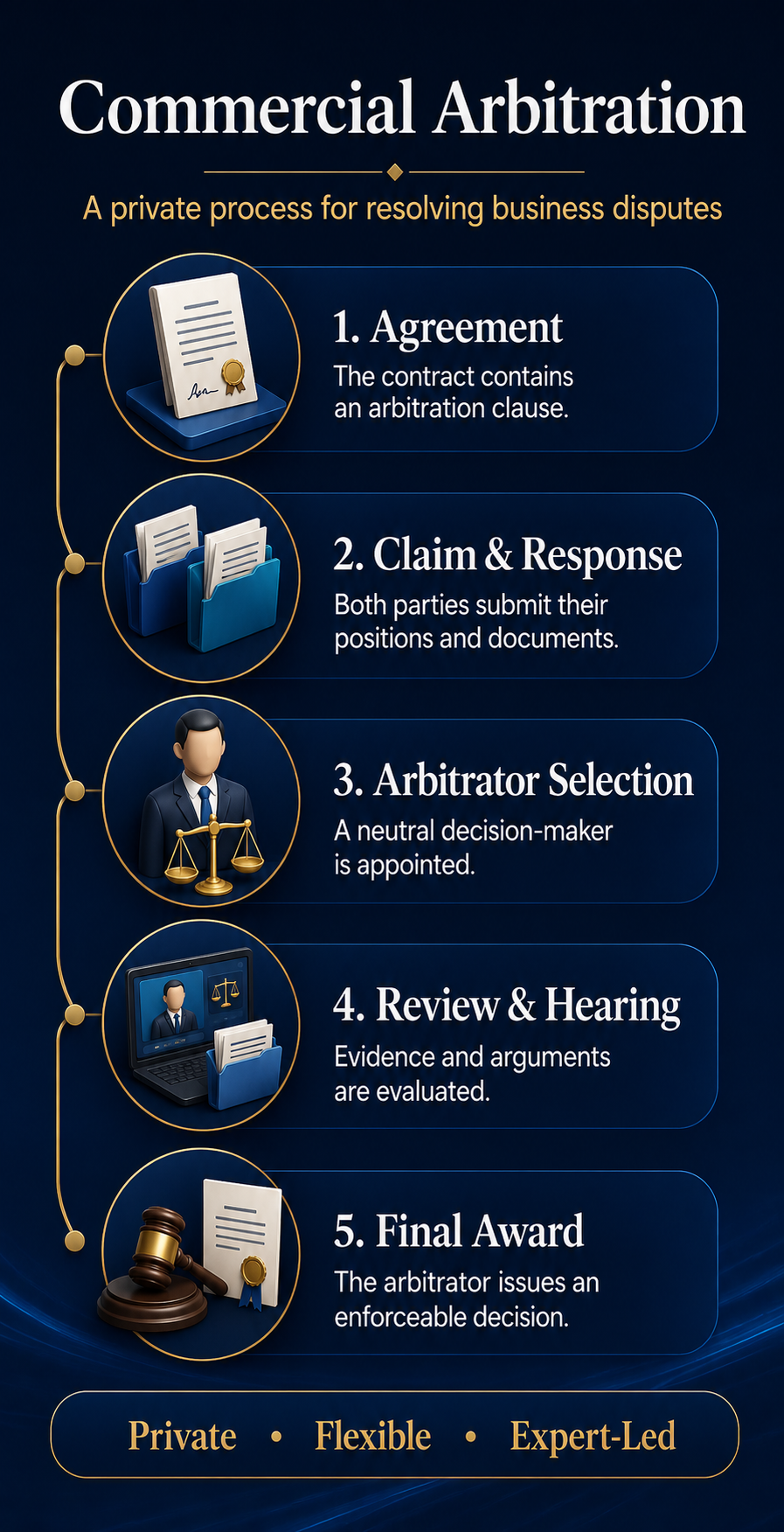
How Arbitral Proceedings Work
Arbitral proceedings usually begin when the claimant submits a demand and claim file under the applicable Commercial Arbitration Rules. The responding party then receives notice and an opportunity to provide a response file, defenses, counterclaims, and supporting documents. Before filing, the claimant should confirm that the arbitration agreement covers the dispute and that required negotiation or Mediation Procedures have been completed. The parties must also review deadlines, service requirements, arbitration fees, and filing instructions. A missed contractual deadline can affect whether a claim proceeds.
The next stage is arbitrator appointment. The dispute may be assigned to one arbitrator or an arbitration panel, depending on the agreement and rules. The completed appointment creates the arbitral tribunal that will manage and decide the case. If a party refuses to arbitrate under a written agreement, Section 4 of the FAA addresses petitions to compel arbitration. Section 5 provides a court appointment procedure for certain situations in which the agreed selection method fails.
The tribunal schedules written submissions, document exchange, motions, witness statements, and any hearing. Parties may submit contracts, invoices, emails, financial records, photographs, expert reports, and other evidence. The Federal Arbitration Act’s Section 7 addresses an arbitrator’s power to summon witnesses and documents in certain cases. Arbitration is not automatically governed by the Federal Rules of Civil Procedure, although selected arbitration rules may use similar concepts. International parties may also agree to evidence standards such as the IBA Rules on the Taking of Evidence in International Arbitration.
A hearing can occur in person, by telephone, or through secure video conferencing. Some small-claim arbitration cases can be decided from the claim file, response file, and documents when the agreement and rules allow it. An online arbitration process can reduce travel and scheduling problems for parties in different locations. Once the record closes, the tribunal issues an award. A reasoned award explains the essential findings and conclusions, while another permitted award format may state only the result and relief.
The Role of the Arbitral Tribunal
The arbitral tribunal manages the proceeding and decides the issues submitted by the parties. Its responsibilities may include determining jurisdiction, setting deadlines, resolving document disputes, considering motions, conducting hearings, evaluating witness credibility, interpreting contracts, and calculating relief. The tribunal must follow the authority granted by the arbitration agreement and applicable rules. In multi-party cases, it may also confront questions involving joinder, consolidation, related contracts, confidentiality, and whether each participant agreed to the same arbitration practice.
Industry-specific expertise can be valuable when a dispute involves technical language or specialized business customs. An arbitrator familiar with construction, financial transactions, healthcare agreements, intellectual property, licensing, manufacturing, or commodities may understand the evidence more efficiently. Information from trade associations can help explain established practices, but the arbitrator must independently evaluate the evidence presented. Expertise never replaces neutrality, procedural fairness, or the parties’ right to be heard.
Arbitrators should disclose relationships or circumstances that could create reasonable concerns about bias. The parties should review the proposed arbitrator’s qualifications, conflicts, availability, legal experience, and ability to manage the expected evidence. Neutrality is important because a binding award has serious financial and operational consequences. A poorly managed proceeding may also increase legal costs, business disruption, and reputational harm. Parties can obtain legal support when interpreting an arbitration clause, presenting complex evidence, or evaluating the consequences of an award.
Commercial Arbitration vs. Litigation
Commercial arbitration can offer private proceedings, flexible scheduling, streamlined procedures, and a decision-maker with relevant expertise. Online document exchange and remote hearings can help businesses in different cities or states participate without repeated travel. Privacy may also reduce the exposure of sensitive contracts, trade information, or allegations that could cause reputational harm. These benefits are strongest when the arbitration agreement clearly defines the claims, procedures, tribunal-selection method, and available remedies.
Arbitration is not automatically faster or less expensive in every dispute. Filing charges, arbitration fees, attorneys, experts, third-party funding, and extensive document exchange can increase the cost of a complex case. Review rights are also narrower than the appeal available after most court judgments. Section 10 of the FAA lists limited grounds for vacating certain awards, including corruption, evident partiality, serious procedural misconduct, or an arbitrator exceeding the granted powers. Section 11 addresses limited modification or correction of an award.
Litigation may be more suitable when a party needs broad court-supervised discovery, a public ruling, ordinary appellate review, or formal joinder of people who never agreed to arbitrate. Courts may also be needed for emergency remedies such as asset freezing, although authority and procedures depend on the jurisdiction, agreement, and facts. Arbitration may work better when the parties value privacy, procedural control, industry expertise, and a final decision. Mediation Procedures can remain useful because parties may negotiate a settlement before or during arbitration.
International Commercial Arbitration and Award Enforcement
International commercial arbitration is used when a business dispute has a meaningful cross-border element. The parties may operate in different countries, performance may occur abroad, or the contract may select a foreign seat of arbitration. The seat connects the proceeding to a jurisdiction’s arbitration law and courts. It is not necessarily where witnesses physically attend the hearing. For every cross-border dispute, the parties should distinguish the governing contract law, procedural law at the seat, and selected arbitral institution rules.
The United Nations Commission on International Trade Law, commonly called UNCITRAL, developed the Model Law on International Commercial Arbitration. It addresses arbitration agreements, tribunal composition, jurisdiction, court involvement, interim measures, and recognition of awards. The Model Law has influenced national legislation across many regions, but it does not replace local law. International treaties, national statutes, the selected rules, and the contract may answer different legal questions within the same arbitration.
For qualifying foreign and non-domestic awards, the New York Convention creates common standards for recognizing arbitration agreements and awards. The Inter-American Convention on International Commercial Arbitration may govern certain matters involving participating countries in the Americas. In the United States, Chapters 2 and 3 of Title 9 address these conventions. Award enforcement and related enforcement proceedings still require the correct court, documents, deadlines, and enforcement procedures. Parties should not assume an international award collects itself.
Evidence collection in cross-border cases can also raise special questions. Section 1782 of Title 28 of the United States Code authorizes certain assistance for proceedings before a qualifying foreign or international tribunal. However, the United States Supreme Court held that the provision does not extend to private adjudicatory bodies simply because they conduct arbitration. Businesses should therefore evaluate the tribunal, governing law, and available discovery tools before relying on Section 1782.
Frequently Asked Questions About Commercial Arbitration
What is the meaning of commercial arbitration?
Commercial arbitration is a private Alternative Dispute Resolution process for deciding disputes arising from business contracts or transactions. The parties authorize a neutral arbitrator or arbitration panel to review evidence and issue an award. Consent is normally recorded in a standard arbitration clause or separate arbitration agreement. When the process is binding, the award generally resolves the submitted claims and may proceed to court for recognition and award enforcement.
What are the three types of arbitration?
There is no universal legal list containing only three types. Arbitration is often classified as domestic or international, institutional or ad hoc, and binding or nonbinding. It can also be grouped by subject, including commercial, consumer, employment, construction, investment, and small-claim arbitration. Businesses should focus on whether the result is binding, which Commercial Arbitration Rules apply, how the tribunal is selected, and which claims are covered by the ADR clauses.
What is the difference between commercial arbitration and investment arbitration?
Commercial arbitration is usually based on a business agreement between private parties. Investment arbitration concerns a qualifying foreign investor and a sovereign state. Its authority may come from an investment treaty, national investment statute, or government agreement. Because the legal foundation differs, investment proceedings can raise separate questions about nationality, protected investments, sovereign conduct, treaty obligations, and tribunal jurisdiction.
Is arbitration a good or bad thing?
Arbitration can be beneficial when parties want privacy, a neutral decision-maker, industry-specific expertise, flexible procedures, and a binding result. It can be less suitable when a dispute requires broad discovery, multiple non-signing parties, public precedent, or ordinary appellate review. Its value depends on the quality of the arbitration clause, applicable rules, costs, tribunal, hearing format, and available enforcement procedures.
Rapid Ruling provides structured online arbitration through document submission, remote hearings, and a binding decision. Review the agreement and rules before filing.
This article provides general information, not legal advice. Consult an attorney about a specific dispute.