
What is a Civil Dispute?

June 17, 2026

Share Article:

Have Any Question?

Settling disputes with our online arbitration services is easy, fast, and affordable.

We look forward to answering your questions and helping you to reach conflict resolution with our online arbitration service.

Recent Posts

What is Family Law Arbitration?

Family law arbitration is a private dispute resolution process where family members present a disagreement to a neutral arbitrator. The arbitrator reviews evidence and applicable law before issuing an arbitration award. Unlike a mediator, an arbitrator decides disputed issues. The decision may be binding or non-binding

Read More »

What is a Civil Dispute?

Construction arbitration is a private dispute resolution process for disputes involving building, engineering, renovation, and infrastructure projects. Instead of presenting the case to a judge or jury, property owners, developers, contractors, subcontractors, design professionals, and suppliers submit

Read More »

What is Construction Arbitration?

Construction arbitration is a private dispute resolution process for disputes involving building, engineering, renovation, and infrastructure projects. Instead of presenting the case to a judge or jury, property owners, developers, contractors, subcontractors, design professionals, and suppliers submit

Read More »

What is Employment Arbitration?

Employment arbitration is an alternative dispute resolution process used to decide conflicts between employers and employees outside a traditional courtroom. The dispute is presented to a neutral arbitrator rather than a judge or jury. Each party can explain its position, submit documents, present
Read More »

What is Commercial Arbitration?

Commercial arbitration is an Alternative Dispute Resolution process for disagreements involving contracts, payments, services, partnerships, and other business matters. Instead of going through a court trial, the parties submit their positions to a neutral arbitrator or arbitral tribunal. The arbitrator

Read More »
Table of Contents

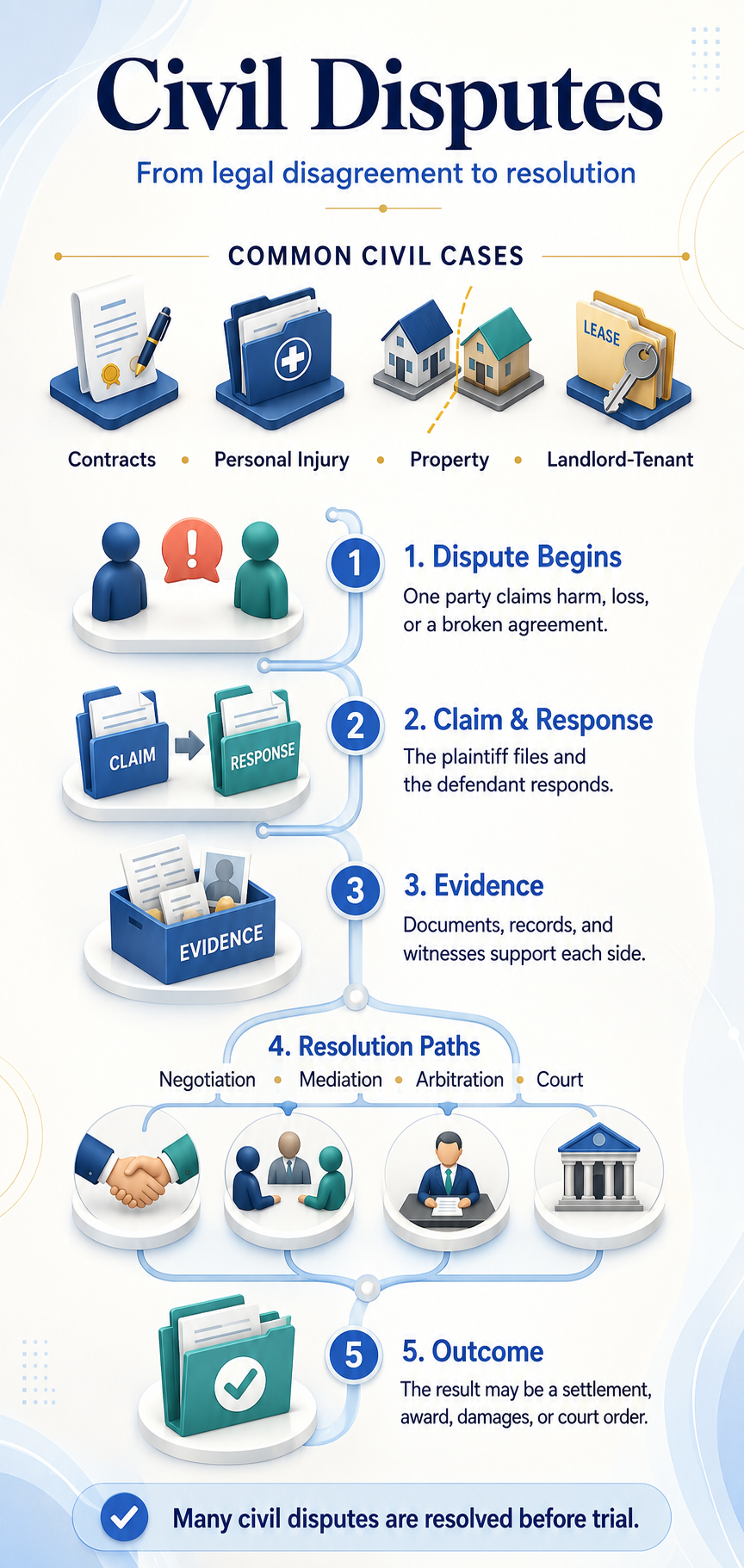
A civil dispute is a legal disagreement between two or more parties. It arises when one party claims another caused harm, violated a duty, or breached an agreement. The claimant may seek compensation, contract enforcement, return of property, or an order stopping certain conduct.

Civil disputes do not always become lawsuits. Many are resolved through direct negotiation, mediation, arbitration, or settlement. Understanding the claims, evidence, procedures, and remedies helps the parties choose an appropriate path.

Understanding Civil Disputes

In civil litigation, the party filing the complaint is the plaintiff, and the responding party is the defendant. Individuals, businesses, and government agencies may participate. A plaintiff must identify a valid claim and request a remedy the court can provide.

Common remedies include compensatory damages for proven losses or injuries. A court may also grant an injunction, order contract performance, or declare the parties’ legal rights. Punitive damages are available only in limited cases under governing law.

Jurisdiction, deadlines, damages, and procedures vary by state and claim. Small claims courts use simplified procedures for lower-value disputes, while complex cases may proceed in other trial courts. The correct forum depends on the parties, location, amount, and legal basis of the dispute.

Common Types of Civil Cases

Contract disputes occur when one party claims that another breached a written, oral, or implied agreement. Examples include unpaid invoices, incomplete services, defective work, missed delivery requirements, and disputes over commercial contract terms. Evidence may include contracts, payment records, emails, invoices, change orders, and performance communications.

Tort claims involve alleged harm caused by wrongful or negligent conduct. Personal injury claims arising from auto accidents, premises liability, defective products, and medical malpractice are examples. A plaintiff may seek payment for medical costs, lost income, property damage, pain and suffering, or other losses permitted by law.

Other civil cases involve property boundaries, landlord-tenant issues, debt collection, employment claims, intellectual property, family law, and disputes among business owners. Class action lawsuits can combine similar claims from many people when legal requirements are met. Although contract, tort, and property matters are often identified as three common categories, no single list applies to every court system.

How a Civil Lawsuit Works

Before filing, a party may send a demand letter, preserve documents, investigate the facts, and attempt settlement. Applicable statutes of limitations should be checked promptly because waiting too long can prevent an otherwise valid claim. Parties should retain contracts, photographs, messages, receipts, medical records, witness information, and other relevant evidence.

According to the United States Courts, a federal civil action begins when the plaintiff files a complaint and serves it on the defendant. The complaint describes the alleged harm, the basis for the court’s jurisdiction, and the requested relief. The defendant can answer the allegations and raise defenses or related claims.

During discovery, the parties exchange relevant information through document requests, written questions, requests for admissions, and depositions. Lawyers may file motions asking the judge to decide procedural or legal issues. If settlement efforts fail and claims remain, the parties present admissible evidence at a jury or bench trial. The judge or jury determines liability, and the court enters a judgment stating the result and remedy.

Civil Disputes vs. Criminal Cases

A civil case generally addresses private rights and remedies. A criminal case is brought by the government to prosecute conduct prohibited by criminal law. Civil defendants may be ordered to pay damages, transfer property, comply with an injunction, or satisfy another remedy. Criminal defendants may face fines, probation, or incarceration if convicted.

The burdens of proof also differ. In most civil cases, the plaintiff must prove the claim by a preponderance of the evidence, meaning it is more likely true than not. Cornell Law School’s Legal Information Institute describes this as showing a greater than 50 percent chance that the claim is true. Criminal guilt must generally be proven beyond a reasonable doubt, which is a higher standard.

The same event can sometimes create both civil and criminal proceedings. An assault, for example, may lead to government prosecution and a separate lawsuit seeking compensation. The cases have different parties, purposes, rules, and possible outcomes.

Resolving Civil Disputes Without a Trial

Direct negotiation may resolve a disagreement before anyone files a complaint. The parties can discuss payment, repairs, contract changes, return of property, confidentiality, or another practical solution. Any settlement should clearly identify the obligations, deadlines, releases, and consequences of nonperformance.

In mediation, a neutral mediator helps the parties communicate and explore settlement, but does not impose a decision. The participants retain control over whether to accept the proposed terms. Mediation can be useful when the parties want a flexible resolution or need to preserve a business, employment, landlord-tenant, or family relationship.

In arbitration, the parties present evidence and arguments to a neutral arbitrator or arbitration panel. The arbitrator then issues an award, which may be binding depending on the agreement and governing law. Online arbitration can allow parties to submit a claim file, response, documents, and testimony remotely. Arbitration may offer scheduling flexibility and streamlined procedures, although fees and limited review rights should be considered.

Frequently Asked Questions About Civil Disputes

What is an example of a civil dispute?

A homeowner could claim that a construction company breached its contract by accepting payment but failing to complete agreed work. The dispute might be resolved through negotiation, mediation, arbitration, or a civil lawsuit seeking damages or completion of the project.

What are the three most common types of civil cases?

Contract disputes, tort or personal injury claims, and property disputes are three broad categories frequently seen in civil courts. Courts also hear landlord-tenant, debt, employment, family law, and business cases. The volume of each type differs by jurisdiction.

How can a civil dispute be solved?

Parties can use direct negotiation, mediation, arbitration, settlement during litigation, or a court trial. The best method depends on the legal issues, urgency, evidence, cost, relationship between the parties, and need for an enforceable decision.

Do I need an attorney to file a civil suit?

Individuals can represent themselves in many civil courts, but they must still follow filing deadlines, evidence rules, and court procedures. Legal advice may be especially valuable when substantial damages, complex laws, business interests, injunctions, or serious personal injuries are involved.

Rapid Ruling provides online mediation and arbitration options for parties seeking to resolve eligible civil disputes outside a traditional courtroom. The available process depends on the parties’ agreement, governing law, and nature of the claim.

This article provides general information and is not legal advice. Consult a qualified attorney regarding a specific claim, filing deadline, arbitration agreement, or court procedure.

Recent Posts

What is Family Law Arbitration?

Family law arbitration is a private dispute resolution process where family members present a disagreement to a neutral arbitrator. The arbitrator reviews evidence and applicable law before issuing an arbitration award. Unlike a mediator, an arbitrator decides disputed issues. The decision may be binding or non-binding

Read More »

What is a Civil Dispute?

Construction arbitration is a private dispute resolution process for disputes involving building, engineering, renovation, and infrastructure projects. Instead of presenting the case to a judge or jury, property owners, developers, contractors, subcontractors, design professionals, and suppliers submit

Read More »

What is Construction Arbitration?

Construction arbitration is a private dispute resolution process for disputes involving building, engineering, renovation, and infrastructure projects. Instead of presenting the case to a judge or jury, property owners, developers, contractors, subcontractors, design professionals, and suppliers submit

Read More »

What is Employment Arbitration?

Employment arbitration is an alternative dispute resolution process used to decide conflicts between employers and employees outside a traditional courtroom. The dispute is presented to a neutral arbitrator rather than a judge or jury. Each party can explain its position, submit documents, present

Read More »

What is Commercial Arbitration?

Commercial arbitration is an Alternative Dispute Resolution process for disagreements involving contracts, payments, services, partnerships, and other business matters. Instead of going through a court trial, the parties submit their positions to a neutral arbitrator or arbitral tribunal. The arbitrator

Read More »
Violet - Product design
Join our email list and file one claim free!*

*terms apply