Benefits, Risks, and Legal Limits of Employment Arbitration
Employment arbitration can offer privacy, flexible scheduling, a neutral decision-maker, and procedures tailored to the dispute. It may avoid some of the delay and formality associated with litigation and a jury trial. Employers can benefit from a consistent dispute resolution system, while employees may gain a more direct path to a hearing. These benefits depend on fair procedures. An arbitration program that creates excessive costs, restricts lawful remedies, or makes evidence unreasonably difficult to obtain may generate enforceability challenges instead of resolving the conflict efficiently.
Arbitration also has potential disadvantages. The parties may need to pay filing costs, arbitrator fees, attorneys, and expert expenses. Discovery may be more limited than it would be in a judicial forum. Arbitration awards generally create no public precedent, and private proceedings can reduce public access to information about workplace conduct. Appeal rights are narrow, even when a party believes the arbitrator misunderstood the facts or law. Employees should not assume that arbitration guarantees a quicker or more favorable outcome, and employers should not treat it as a way to avoid accountability.
Mandatory arbitration can also affect class action lawsuits and collective wage claims. Some employment agreements require claims to proceed individually, and the Supreme Court has enforced certain agreements containing individual arbitration provisions. However, enforceability depends on the exact contract, governing law, and claim. Employees should review whether the clause includes a class or collective action waiver, and employers should avoid language that interferes with rights that cannot lawfully be waived. A provision that is enforceable in one context may not control a different statutory or representative claim.
Federal law creates an important exception for disputes involving sexual assault or sexual harassment. Under Chapter 4 of the Federal Arbitration Act, a person alleging qualifying conduct may elect not to enforce a predispute arbitration agreement or predispute joint-action waiver for a case relating to that dispute. This does not mean every workplace disagreement becomes exempt from arbitration. The allegations, timing, claims, and statutory definitions matter, and the choice belongs to the person asserting the covered conduct.
An employment arbitration agreement also cannot prevent an employee from filing a discrimination charge with the Equal Employment Opportunity Commission. The EEOC explains that it remains available to receive and investigate charges even when private parties have an enforceable arbitration agreement. The agency is not a party to that private agreement and may pursue public enforcement when authorized. Employees still need to follow applicable filing deadlines, which can be much shorter than the time available for other legal claims.
Transportation-worker status can create another federal issue. Section 1 of the FAA excludes certain employment contracts involving seamen, railroad employees, and other transportation workers engaged in interstate or foreign commerce. Whether a worker qualifies depends on the work performed, not merely a job title or the employer’s industry label. If the FAA exemption applies, another federal law, state arbitration law, or contract rule may still affect the dispute. The exemption should therefore be analyzed rather than treated as an automatic end to arbitration.
Arbitration does not always remove a related lawsuit from the court system permanently. A party may ask a court to compel arbitration, challenge whether an agreement was formed, or later seek confirmation or limited review of an award. In Smith v. Spizzirri, the Supreme Court held that when a federal court finds a lawsuit arbitrable and a party requests a stay, Section 3 of the FAA requires the court to stay the case rather than dismiss it. The court proceeding can therefore remain paused while arbitration moves forward.
Fair drafting helps both employees and employers understand the process before a dispute begins. An employment arbitration clause should use readable language and clearly identify covered claims, governing rules, arbitrator selection, hearing format, discovery, fees, available remedies, confidentiality, and award requirements. Employers should provide notice and a meaningful opportunity to review the agreement. They should also update arbitration programs when federal or state law changes. Employees may represent themselves when the rules allow it, but legal advice can be valuable when the dispute involves statutory rights, substantial damages, or a challenge to enforceability.
Frequently Asked Questions About Employment Arbitration
How does employment arbitration work?
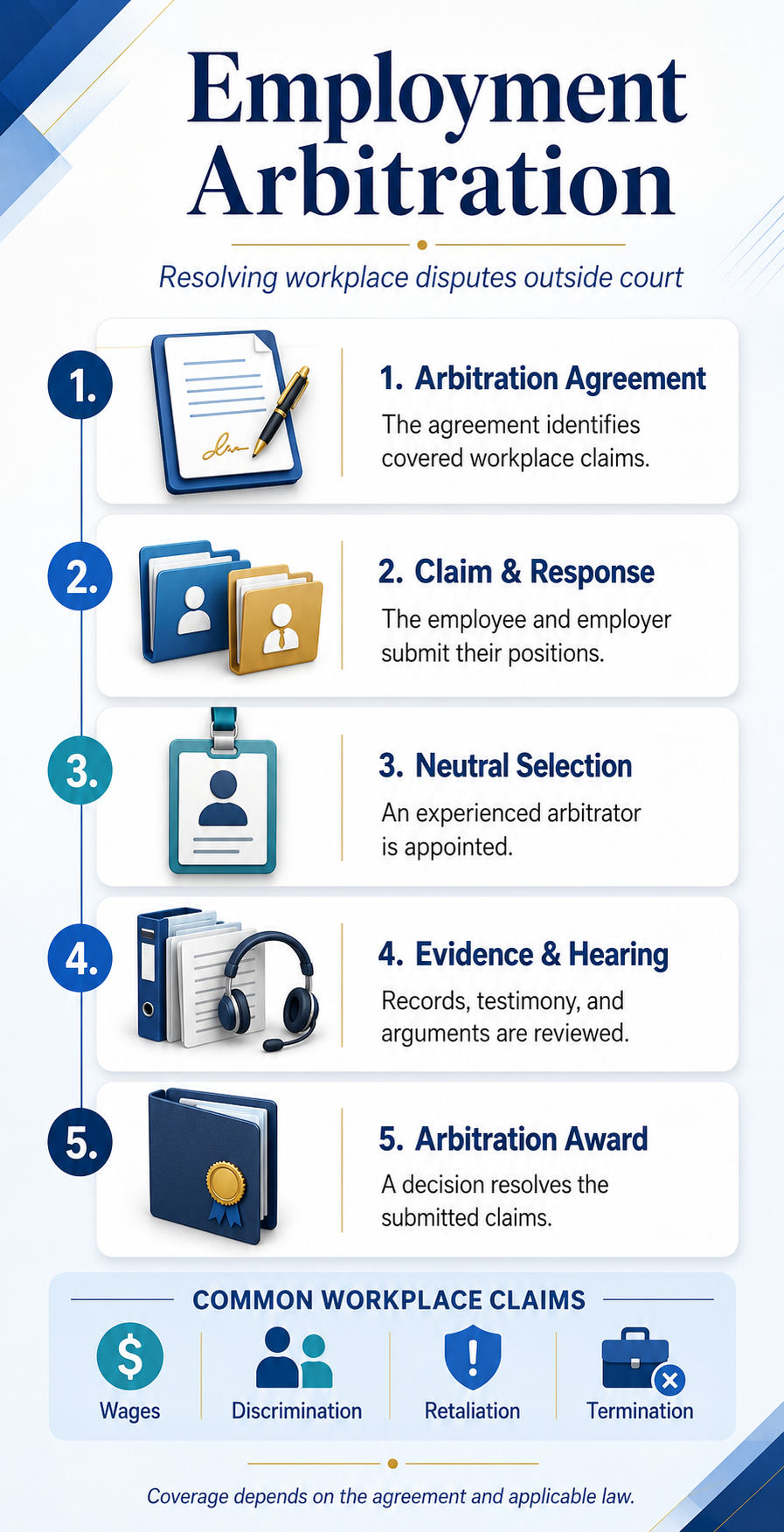
One party files a demand under an employment arbitration agreement and provides notice to the other party. A neutral arbitrator is selected, a schedule is established, and the parties exchange relevant evidence. Each side then presents testimony, documents, and legal arguments at an in-person or online hearing. The arbitrator reviews the record and issues an arbitration award. If the process is binding, that award usually resolves the private claims submitted for decision.
How often do employees win in arbitration?
There is no reliable universal win rate for employees. Results vary according to the claim, evidence, representation, industry, selection method, case value, and dataset being studied. Published research has reported materially different outcomes across types of employment cases. Older Cornell employment-arbitration research reported an employee win rate below 20% in one dataset, but that figure should not be treated as a prediction for a current claim. Every case turns on its own record and governing law.
Does arbitration mean you cannot sue?
An enforceable arbitration agreement may prevent a person from pursuing covered private claims through a trial by jury. It does not eliminate every connection to court or government enforcement. A court may decide whether an agreement exists, compel arbitration, stay litigation, or enforce an award. Employees may still file qualifying charges with government agencies, and federal law gives people alleging certain sexual assault or harassment disputes a choice regarding predispute arbitration. The precise answer depends on the agreement, claim, and applicable law.
How long does employment arbitration take?
Employment arbitration can take several months, but no fixed duration applies. The timeline depends on arbitrator availability, discovery, motions, witnesses, experts, hearing length, and the complexity of the employment claims. A focused case decided mainly through documents may move faster than litigation. A dispute involving several claims, extensive records, or a contested arbitration agreement can take much longer. Clear scheduling, timely submissions, and remote hearings can reduce avoidable delays.
Rapid Ruling provides a structured online process for submitting evidence, attending remote hearings, and receiving a binding decision when the parties have agreed to arbitrate. The agreement, governing rules, and applicable employment laws should be reviewed before filing.
This article provides general information, not legal advice. Employees and employers should consult a qualified attorney about a specific agreement or workplace dispute.