Online Mediation vs. Traditional Mediation
Online mediation and traditional in-person mediation share the same purpose. Both use a neutral mediator to help parties communicate and negotiate. Both are focused on settlement instead of winning a court battle. Both allow parties to discuss the dispute in a confidential setting and search for practical solutions.
The main difference is the setting. Traditional mediation usually happens in an office, conference room, courthouse, mediation center, or law firm. The parties may sit in the same room, separate rooms, or move between rooms while the mediator manages the conversation. This can work well when body language, seating arrangements, physical documents, and face-to-face interaction are important.
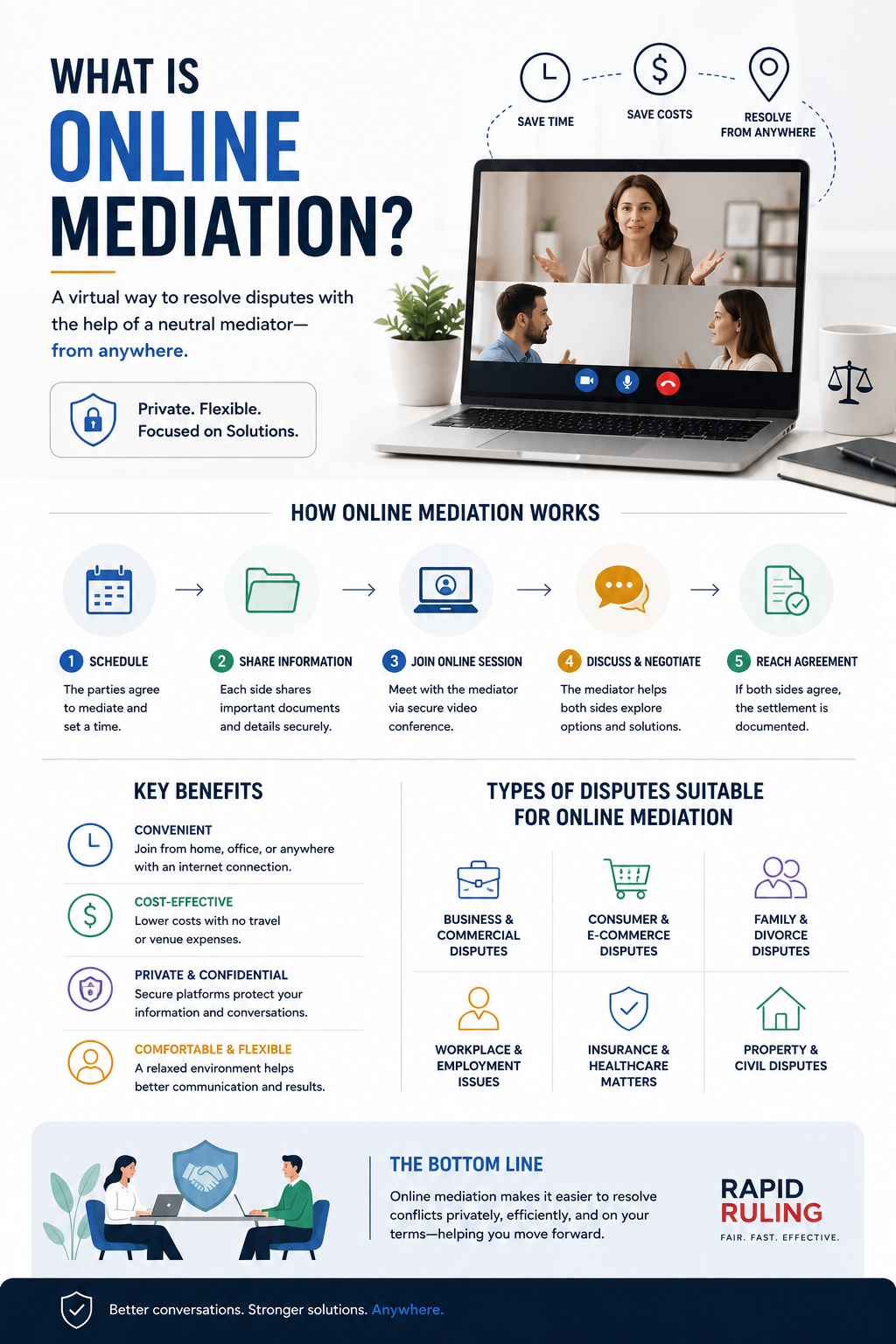
Online mediation uses information technology to conduct some or all of the process virtually. Harvard Law School’s Program on Negotiation describes online mediation as mediation that relies on at least some use of information technology while remaining a voluntary process, similar to in-person mediation. Instead of traveling to a physical location, the parties may attend by Zoom, Microsoft Teams, or another secure video conferencing platform.
The online format can make mediation more accessible. A business owner, employee, consumer, contractor, or family member may be able to participate from home, work, or another private location. This can reduce travel costs, missed work, and scheduling conflicts. It can also help when parties are in different cities, states, or countries.
There are tradeoffs. In-person mediation may make it easier for the mediator to read body language, manage intense emotions, or create a more formal setting. Online mediation depends on internet connection, camera quality, privacy, and participant comfort with technology. A strong mediator knows how to adjust their communication style for the virtual environment so each side still feels heard.
What Types of Disputes Can Online Mediation Resolve?
Online mediation can help many parties resolve disputes before they escalate into litigation or arbitration. It is especially useful when the parties want to preserve control over the outcome, avoid public court proceedings, and reduce costs. Because the process is flexible, it can be used for both personal and business conflicts.
Commercial disputes are a common fit. Businesses may use online mediation to resolve contract disagreements, unpaid invoices, service complaints, vendor issues, partnership conflicts, customer disputes, and disagreements over performance. For companies, the main benefit is efficiency. A mediated settlement can help avoid disruption, protect business relationships, and keep legal costs from overwhelming the value of the dispute.
Consumer and eCommerce disputes are also well-suited for online mediation. When a customer and business disagree over a product, refund, service failure, subscription, or payment issue, a virtual process can be more practical than small claims court. This is especially true when the parties are in different locations or the amount at stake does not justify travel and court appearances.
Family disputes may also be handled through online mediation. This can include online divorce mediation, parenting schedules, finances and property, communication issues, and other family conflicts. Harvard’s Program on Negotiation has noted that online mediation is now used for emotional, personal, and private conflicts, including family and workplace mediation.
Workplace and employment issues may also benefit from virtual mediations. These disputes can involve wrongful termination claims, wage disputes, discrimination concerns, harassment allegations, workplace conflict, or separation negotiations. Online mediation gives the parties a private space to address sensitive issues without immediately moving into formal litigation.
Online mediation may also be used for insurance and healthcare matters, property disputes, monetary claims, civil disputes, and community conflicts. It is not right for every situation, especially where there are safety concerns, severe power imbalances, bad-faith participation, or urgent court remedies needed. But for many disputes, it offers a practical path toward settlement.
Benefits of Online Mediation
One of the biggest benefits of online mediation is convenience. Parties do not need to travel to the same location, reserve a full day for an in-person meeting, or coordinate complicated schedules around a courthouse or mediation office. This can make the process easier for busy professionals, families, remote workers, business owners, and participants in different locations.
Cost-effectiveness is another major advantage. The cost of traditional mediation may include mediator fees, attorneys’ fees, travel, parking, lost work time, room fees, printing, and preparation expenses. Online mediation may still involve fees or an hourly rate, but it can reduce many of the extra costs connected to in-person sessions. For smaller claims or disputes where the parties want to control expenses, this can make mediation more realistic.
Online mediation can also increase participant comfort. Some people communicate more calmly when they are in a familiar environment. A party who might feel intimidated by a formal office or courtroom may feel more prepared to speak from home or another private space. That comfort can support better communication, especially in emotionally charged disputes.
Privacy is another benefit. Mediation is generally designed to be confidential, and online mediation can support that goal with private breakout rooms, secure links, confidential file-sharing, and controlled access to documents. This matters when the dispute involves financial information, family issues, employment claims, healthcare concerns, customer information, or sensitive business records.
Online mediation may also help disputes move faster. Court cases can be slowed down by crowded calendars, procedural filings, court fees, and formal hearings. Mediation gives parties a way to address the conflict directly and search for settlement before the dispute becomes more expensive. AAA’s ODR resources emphasize that online dispute resolution uses technology to resolve conflicts efficiently and reduce the need for in-person meetings or lengthy procedures.
What Not to Say or Do During Online Mediation
Online mediation works best when each party approaches the process with preparation, patience, and a willingness to listen. That does not mean a party has to agree with everything the other side says. It means the goal should be settlement, not simply proving anger or frustration.
One thing to avoid is absolute language that closes the door to negotiation. Statements like “I will never settle,” “there is nothing to discuss,” or “they are completely wrong about everything” can make progress harder. Strong positions are common in mediation, but productive negotiation usually requires some room to explore options.
Parties should also avoid personal attacks. Mediation can involve strong emotions, especially in family, workplace, property, and financial disputes. However, insults and accusations can make the other side more defensive. A mediator can help reframe concerns into settlement-focused language. For example, instead of saying, “You lied about everything,” a party may be encouraged to say, “I do not agree with that version of the events, and here is the evidence I want considered.”
It is also unwise to disclose confidential information carelessly. Participants should make sure they are in a private room, using a secure internet connection, and not allowing unauthorized people to listen. Sensitive documents should be shared through the approved platform or process rather than casually forwarded without direction.
Parties should not treat online mediation like an informal video call. It is still a serious dispute resolution process. Showing up late, multitasking, texting others during the session, appearing from a noisy location, or failing to review documents can weaken credibility and slow progress. Good preparation matters, even when the meeting is virtual.
Finally, parties should avoid making settlement offers they do not understand. If attorneys are involved, they can help review terms before anything is finalized. If a settlement is reached, the agreement should be clear, specific, and written in a way that reduces future misunderstandings.
Common Challenges in Virtual Mediation
Online mediation has many advantages, but it also comes with challenges. The most obvious is technology. A weak internet connection, poor audio, frozen video, or unfamiliar platform can interrupt the mediation process. Participants should test their device, camera, microphone, and internet connection before the session begins.
Another challenge is reading body language. In-person mediation allows a mediator to observe posture, eye contact, side conversations, and subtle reactions. In the virtual environment, some of those signals may be harder to see. Skilled mediators adjust by asking more direct questions, checking for understanding, and using private sessions to make sure each party is engaged.
Maintaining focus can also be harder online. Participants may be tempted to check email, answer texts, or handle work during the session. That can slow the process and make the other side feel dismissed. A successful online mediation requires the same attention as an in-person session.
Confidentiality requires extra care. A participant may be joining from home, an office, a vehicle, or a shared space. Before the session begins, the mediator may ask whether anyone else is present and whether the participant can speak privately. This is especially important for family disputes, workplace issues, healthcare matters, and cases involving sensitive financial or personal information.
Power imbalance can also be a concern. If one party feels pressured, intimidated, or unable to participate freely, online mediation may need additional safeguards. The mediator may use separate sessions, structured communication rules, or attorney participation to support fairness. In some cases, mediation may not be appropriate if one side cannot safely or meaningfully participate.
Despite these challenges, online mediation has become a serious part of modern conflict resolution. The key is choosing the right mediator, using the right platform, preparing documents ahead of time, and creating a process that keeps everyone focused on settlement.
Choosing Online Mediation With Rapid Ruling
Online mediation gives parties a practical way to resolve conflict without immediately turning to court litigation. It combines the structure of the mediation process with the flexibility of digital platforms, virtual meetings, online document sharing, and secure communication tools. For many disputes, that balance can reduce costs, save time, and help both sides focus on settlement instead of escalation.
Rapid Ruling’s online mediation approach is designed for people and businesses that want resolution without unnecessary roadblocks. Whether the dispute involves a contract, payment issue, business disagreement, consumer complaint, workplace matter, family conflict, property issue, or civil claim, online mediation can provide a private and organized space to work through the problem.
The process can also fit naturally with other forms of alternative dispute resolution. If mediation succeeds, the parties may leave with a settlement agreement. If mediation does not resolve the conflict, they may still consider online arbitration, traditional arbitration, or court. This flexibility is one of the reasons online dispute resolution continues to grow across courts, businesses, universities, and professional dispute resolution organizations. The AAA’s acquisition of ODR.com in 2024 reflected the growing role of digital access to justice and online platforms in resolving disputes for courts, businesses, and communities.
For parties wondering whether online mediation is worth trying, the answer often depends on the goal. If the goal is to punish the other side, mediation may not be the right mindset. But if the goal is to save time, reduce costs, protect privacy, and reach a workable settlement, online mediation can be a strong option.
Disputes can be stressful, expensive, and disruptive. Online mediation gives parties a more accessible way to be heard, exchange information, and work toward a resolution. With the right mediator and a clear process, it can turn a difficult conflict into a structured conversation with a real chance of settlement.