Common Construction Claims and the Evidence They Require
Payment disputes are among the most common construction claims. A contractor may seek an unpaid contract balance, approved change-order compensation, retainage, or payment for extra work. An owner may argue that payment is not due because work is incomplete, defective, delayed, or unsupported. Relevant evidence may include the signed contract, schedule of values, payment applications, invoices, lien waivers, daily reports, inspection records, correspondence, photographs, and proof showing whether the disputed work was authorized and completed.
Delay and disruption claims require more than showing that a project finished late. The claimant generally needs to connect a responsible event to an actual effect on the project schedule and resulting damages. Evidence can include baseline schedules, schedule updates, critical-path analysis, requests for information, submittal logs, weather records, manpower reports, meeting minutes, change directives, and cost records. The opposing party may argue that the delay was concurrent, excusable, caused by the claimant, or already addressed through a time extension or contract modification.
A construction defect case may involve workmanship, materials, plans, specifications, code compliance, water intrusion, structural performance, mechanical systems, or another claimed failure. The dispute often turns on who was responsible for the condition and whether the work departed from the contract or accepted standard of care. Photographs, testing, inspection reports, repair estimates, as-built drawings, product information, and site observations can be important. The parties should preserve physical evidence before destructive testing, repairs, or demolition changes the condition being evaluated.
Expert witnesses can help explain technical questions that are outside ordinary experience. Engineering experts may address structural performance, geotechnical conditions, design responsibility, mechanical systems, or construction defects. Scheduling experts may analyze critical-path delay, and damages experts may evaluate labor inefficiency, extended overhead, or repair costs. Small and mid-sized disputes do not always require an expert. The likely value of expert testimony should be compared with the amount in dispute, complexity of the issue, and whether a qualified fact witness can explain the evidence adequately.
Project teams should preserve documentation before a disagreement becomes a formal arbitration claim. Field personnel should record delays, instructions, differing site conditions, rejected work, labor impacts, material deliveries, and conversations affecting cost or time. They should also follow the contract’s written notice requirements rather than relying on informal discussions. Organized claim documentation helps the parties evaluate settlement, prepare the arbitration demand, respond to allegations, and identify gaps while records and witness memories are still available.
Insurance, bond, lien, and indemnity issues may continue alongside arbitration. A liability insurer may have separate notice, defense, consent, or coverage requirements. A surety may request its own claim documentation under a payment or performance bond. Mechanic’s lien deadlines may also continue running even when the contract requires arbitration. Because these rights arise from different contracts and statutes, starting arbitration should not be assumed to preserve every insurance, bond, or lien claim automatically.
Selecting an Arbitrator and Drafting an Effective Clause
A construction arbitrator should be neutral, available, and capable of managing the size of the dispute. Industry-specific expertise can help when the case involves specialized schedules, engineering standards, cost accounting, design documents, or trade practices. Relevant experience may come from construction law, project management, architecture, engineering, accounting, or prior construction cases. The parties should review qualifications, conflicts, hearing approach, availability, rates, and experience with the governing law before completing the appointment.
An effective arbitration clause should identify the disputes covered, governing rules, number of arbitrators, appointment method, hearing location, choice of law, and language of the proceedings. It should also address discovery, confidentiality, fees, available remedies, and whether a reasoned award is required. Projects involving several contracts should consider joinder and consolidation. Without compatible disputes provisions, an owner could face one proceeding with the general contractor and another involving a designer or subcontractor over the same underlying condition.
The clause should fit the project rather than copy language designed for an unrelated transaction. Fast Track Procedures may work for a focused payment dispute but may not provide enough time for a complex defect or delay claim. Large projects may need staged discovery, multiple experts, a panel, or procedures for early rulings on controlling issues. Parties can sometimes amend an arbitration clause after signing, but the change requires valid agreement from the affected parties and should be documented clearly before anyone relies on it.
Early dispute avoidance can be more valuable than winning a formal claim after the project has suffered. Regular executive meetings, project neutrals, and dispute review boards can address issues while work continues. ConsensusDocs explains that Dispute Review Boards are often used on large and complex projects to help minimize or resolve disputes. These tools do not automatically replace arbitration. Their authority, confidentiality, deadlines, and relationship to later proceedings should be defined in the contract.
Construction Arbitration vs. Litigation and Mediation
Arbitration can provide privacy, flexible scheduling, streamlined discovery, and a decision-maker with construction experience. The parties can choose an in-person or online hearing and create deadlines that fit the dispute. These features may reduce business disruption and help a project move forward while the claim is addressed. Rapid Ruling’s construction online dispute resolution services allow project participants to submit records and participate remotely when the agreement permits online arbitration.
Arbitration is not automatically inexpensive or fast. Arbitrator compensation, filing charges, attorneys, document review, depositions, expert witnesses, and hearing expenses can make a large construction case costly. Mega-project disputes involving many parties, several experts, and years of project records may resemble complex litigation. Appeal rights are also narrow. These disadvantages make early case planning important. The parties should define the issues, separate strong claims from weak ones, organize damages, and avoid unnecessary discovery that does not help the arbitrator decide the dispute.
Mediation can be used before or during arbitration. A mediator does not decide who wins. The mediator helps the parties assess risk, exchange proposals, and search for a voluntary settlement. Arbitration produces a decision when settlement is not reached. Some contracts use a stepped disputes provision requiring project-level negotiation, mediation, and then binding arbitration. The federal government’s Alternative Dispute Resolution guidance similarly recognizes that parties can agree to procedures used in place of formal litigation, although public contracts have their own requirements.
Frequently Asked Questions About Construction Arbitration
How does construction arbitration work?
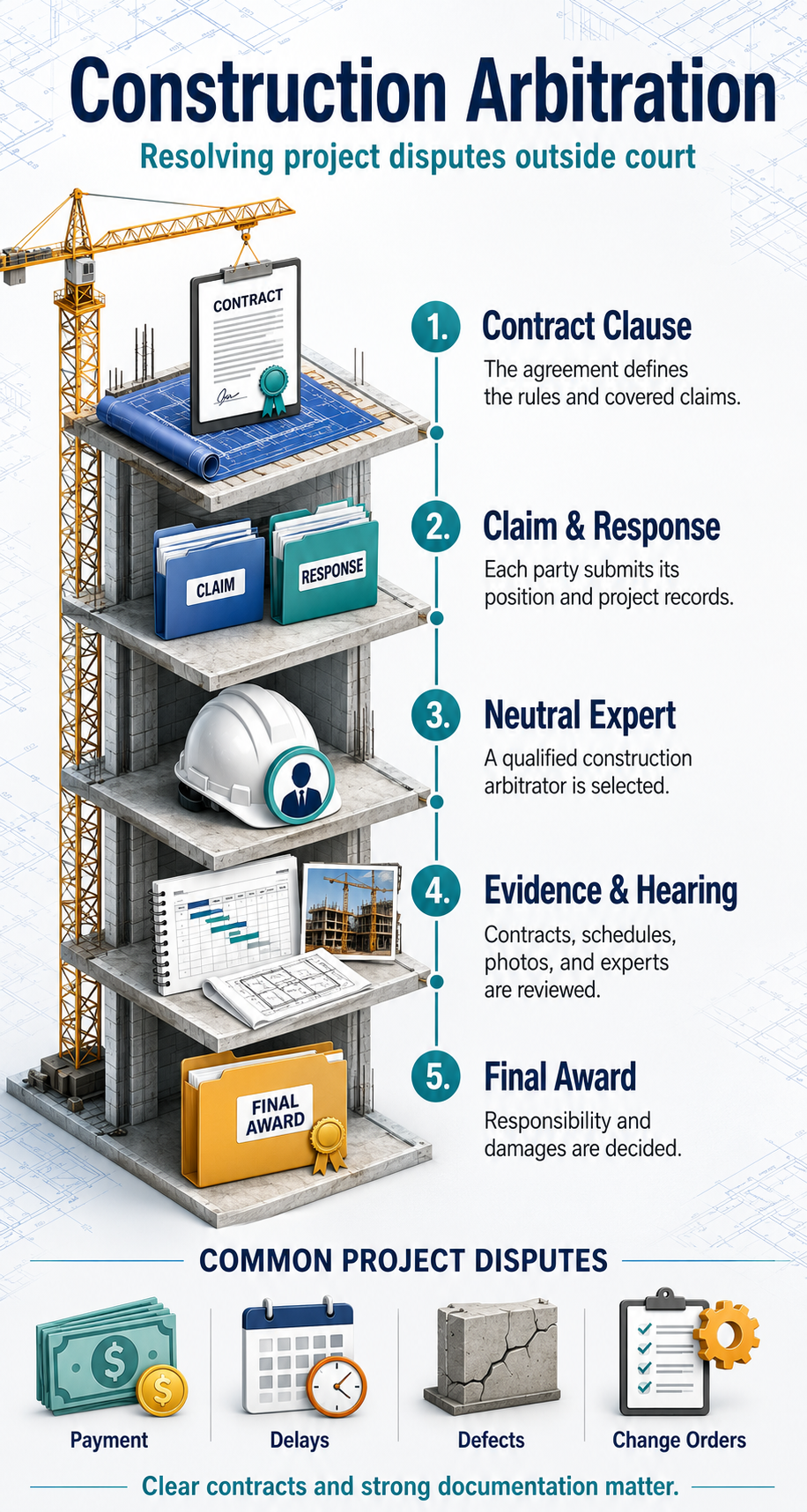
A party files a demand under a construction contract’s arbitration clause and provides notice to the other parties. A neutral arbitrator or panel is selected, a scheduling order is issued, and relevant documents are exchanged. The parties then present witnesses, expert opinions, project records, and contract arguments at a hearing. The arbitrator evaluates responsibility and damages before issuing an award that may be confirmed and enforced through a court.
Who usually wins construction arbitration?
There is no party that usually wins simply because it is an owner, contractor, or subcontractor. Results depend on the contract, required notices, project records, witness credibility, technical evidence, damages, and applicable law. A party with organized documentation may still lose if the contract assigns the risk differently or the claimed damages are unsupported. Each claim must be evaluated on its own facts rather than general win-rate assumptions.
Is construction arbitration a good or bad thing?
Construction arbitration can be beneficial when the parties want privacy, flexible procedures, technical expertise, and a binding decision. It can be less suitable when the dispute requires broad discovery, many non-signing parties, public precedent, or ordinary appellate review. Its value depends heavily on the arbitration clause and case management. A clear clause and disciplined evidence can make the process more useful, while vague procedures can create delay and added expense.
Who usually pays for construction arbitration?
Payment responsibilities vary. The contract or arbitration rules may require the parties to divide filing and arbitrator fees, make deposits, or assign initial payments differently. Each side commonly pays its own attorneys and experts unless a contract, statute, or award allows those expenses to be shifted. The arbitrator may allocate some costs in the final decision when authorized. Reviewing the fee provisions before filing helps prevent unexpected expenses.
Rapid Ruling provides secure online arbitration for construction and engineering disputes. Parties can submit documents, attend remote hearings, and receive a binding decision.
This article provides general information, not legal advice. Consult a construction attorney about a specific dispute.