Binding Arbitration vs. Non-Binding: What’s the Difference?
July 4, 2026
Share Article:
Settling disputes with our online arbitration services is easy, fast, and affordable.
We look forward to answering your questions and helping you to reach conflict resolution with our online arbitration service.
How to Respond to an Arbitration Claim Filed Against You
Practical steps for responding to an arbitration claim before the deadline.
What to Look for in an Arbitrator: Neutrality, Experience and Process
The qualities that matter when an arbitrator is assigned or chosen.
Can You Be Forced Into Arbitration? When Clauses Are Enforced
When a valid arbitration clause requires you to arbitrate, and when it may not.
Arbitration Agreement vs Arbitration Clause: What Is the Difference?
The difference between an arbitration clause and an arbitration agreement.
What Is a Mediated Settlement Agreement and Is It Binding?
How a mediated deal becomes a written, enforceable agreement.
Table of Contents
Binding arbitration and non-binding arbitration are two forms of alternative dispute resolution that allow parties to resolve conflicts outside a traditional trial. In both processes, a neutral arbitrator reviews evidence, hears arguments, and issues an award. The major difference is what happens next. A binding arbitration award is generally final and may be enforced by a court, while a non-binding award is advisory unless the parties accept it. That distinction affects legal remedies, settlement negotiations, costs, and the ability to continue to court. For businesses, employees, property owners, and consumers, understanding the contract terms before arbitration begins can prevent major surprises later.
What Is Arbitration and How Does the Process Work?
Arbitration is a private dispute resolution process that gives a neutral decision-maker authority to evaluate a conflict. The American Bar Association explains that arbitration can be binding or non-binding and is generally less formal than a courtroom trial. Parties may present documents, testimony, witnesses, and legal arguments, often with help from attorneys or other legal representatives. Arbitration may result from an arbitration clause already written into a contract, an agreement reached after a dispute begins, or a court-ordered arbitration program. The exact procedure depends on the arbitration agreement, governing law, and arbitration rules selected for the case.
Arbitration is used across many kinds of conflicts. Commercial arbitration can involve contract disputes, vendor disagreements, consumer claims, or small business disputes. Construction arbitration may involve contractors, developers, property owners, payment conflicts, and infrastructure projects. Employment arbitration can address certain employment disputes, while family law arbitration may be available for some family law matters depending on the jurisdiction. Because every dispute involves different rights, parties should review the scope of the agreement, available legal remedies, discovery rules, costs, and possible conflicts of interest. Rapid Ruling provides online arbitration services for parties seeking an alternative to traditional litigation.
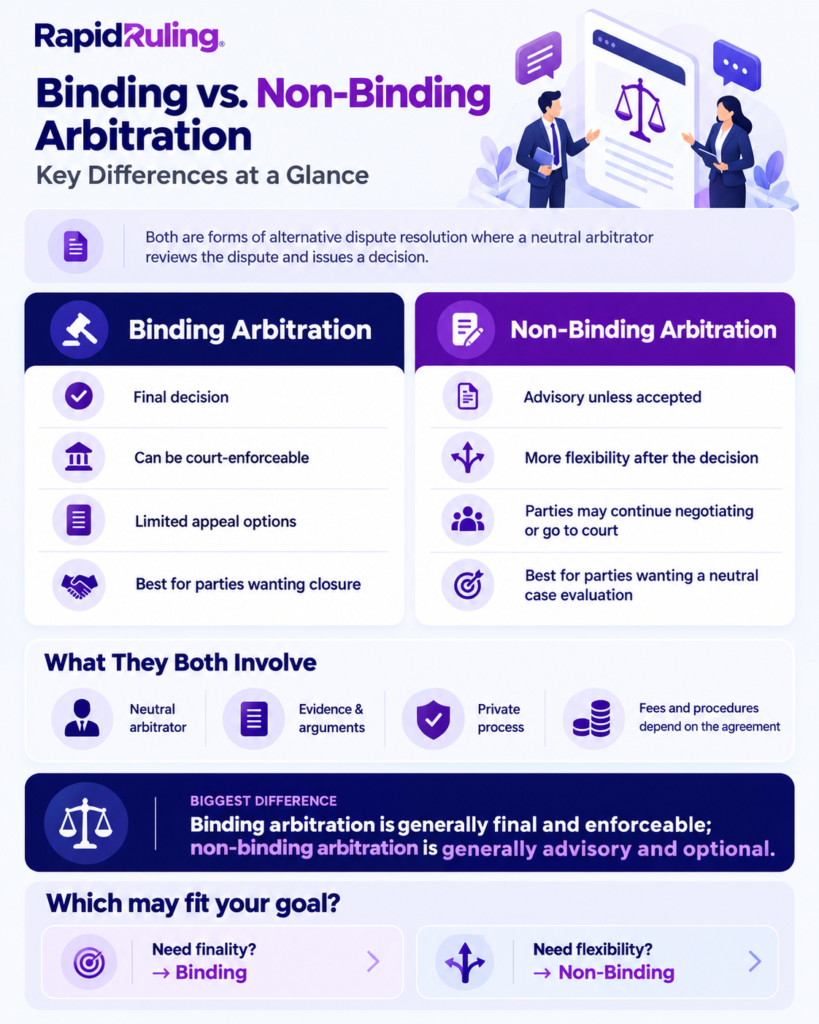
Binding vs. Non-Binding Arbitration: What Are the Key Differences?
The largest difference between binding and non-binding arbitration is enforceability. Binding arbitration is intended to resolve the dispute and can ultimately produce a court-enforceable arbitration award. Non-binding arbitration is generally designed to evaluate the dispute while preserving more flexibility. Binding arbitration may offer greater finality and avoid a lengthy jury trial, but opportunities to challenge the result are limited. Non-binding arbitration leaves more room for further communication and settlement negotiations, but the dispute may continue if the parties reject the outcome. Both processes can involve evidence, witnesses, legal representatives, expert opinions, confidentiality provisions, discovery, filing expenses, and arbitrator fees.
| Factor | Binding Arbitration | Non-Binding Arbitration |
|---|---|---|
Legal Enforceability | Final and legally binding | Advisory only, not legally enforceable |
Appeal Process | No appeals, except in rare cases | Parties can reject the ruling |
Decision-Making Authority | Arbitrator’s ruling is final | Parties retain the right to go to court |
Confidentiality | Private proceedings | Often private, but can lead to public trials |
Cost Implications | Reduces attorney fees and arbitration fees | Can result in additional costs if litigation follows |
Arbitration can also use specialized structures that change financial risk. In High-Low Arbitration, the parties may agree in advance to a minimum and maximum financial outcome. Bracketed Arbitration also establishes agreed boundaries that affect how the ultimate award is treated. These structures may appear in commercial arbitration, construction arbitration, consumer claims, or other disputes where the parties want more control over financial exposure. They do not change the basic need for clear contract terms. The parties should understand whether the process is binding, what remedies are available, how confidentiality works, who selects the arbitrator, and whether any conflict of interest could affect the fairness of the proceedings.
Should You Choose Binding or Non-Binding Arbitration?
Whether binding or non-binding arbitration makes sense depends on the dispute and the goals of the parties. Binding arbitration may appeal to parties seeking finality, a private dispute resolution process, or a specialized decision-maker without proceeding through a complete courtroom trial. However, limited appeal options can be a significant consideration. Non-binding arbitration may be more useful when parties want an independent case evaluation while preserving the ability to negotiate, pursue mediation, or continue to court. Employment disputes, commercial conflicts, family law matters, construction disputes, small business disputes, and consumer claims can all present different concerns, so the right structure depends on the governing agreement and applicable law.
Before arbitration begins, review the arbitration agreement carefully. Important questions include who selects the arbitrator, which disputes are covered, whether the decision will be binding, what evidence and discovery are allowed, how arbitration costs are divided, and what legal remedies the arbitrator can award. Parties should also consider confidentiality, settlement options, conflicts of interest, hearing procedures, enforcement tools, and any deadlines for challenging or accepting an award. Understanding these terms before the hearing provides a clearer picture of the risks and possible outcomes. Rapid Ruling helps parties use a structured arbitration process to resolve disputes without relying solely on traditional courtroom litigation.
How to Respond to an Arbitration Claim Filed Against You
Practical steps for responding to an arbitration claim before the deadline.
What to Look for in an Arbitrator: Neutrality, Experience and Process
The qualities that matter when an arbitrator is assigned or chosen.
Can You Be Forced Into Arbitration? When Clauses Are Enforced
When a valid arbitration clause requires you to arbitrate, and when it may not.
Arbitration Agreement vs Arbitration Clause: What Is the Difference?
The difference between an arbitration clause and an arbitration agreement.
What Is a Mediated Settlement Agreement and Is It Binding?
How a mediated deal becomes a written, enforceable agreement.