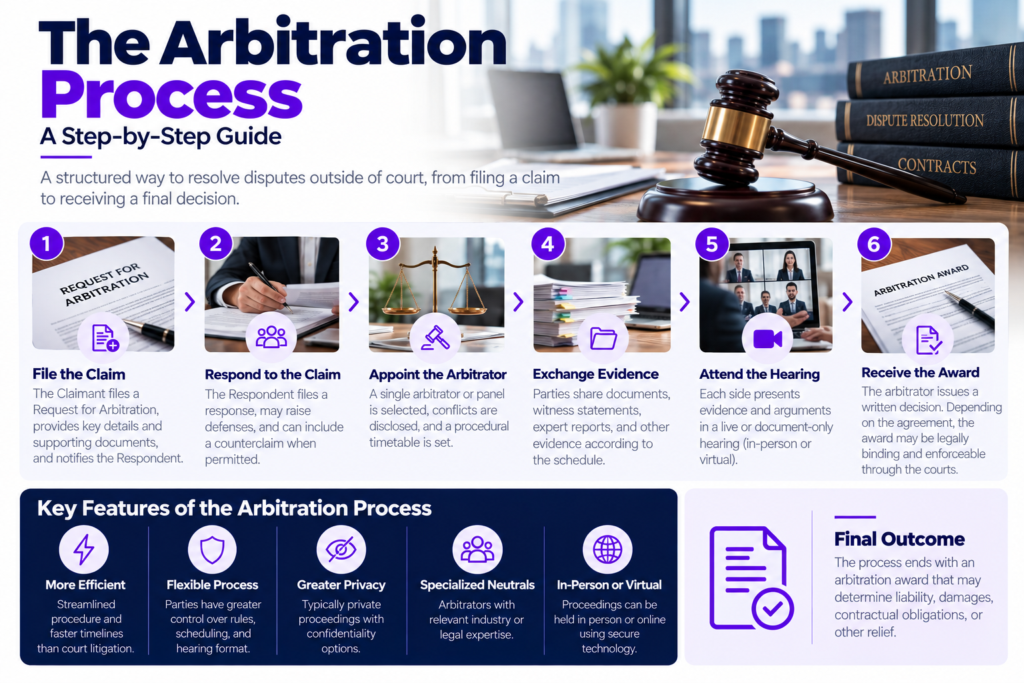
Step 1: File the Request and Notify the Respondent
The process normally begins when the Claimant files a Request for Arbitration or similar demand. The filing should identify the parties, explain the nature of the dispute, state the relief requested, and include the arbitration agreement or dispute resolution clause that gives the tribunal authority to hear the case. Depending on the applicable rules, the Claimant may also submit a Statement of Claim, supporting affidavit, contracts, invoices, photographs, correspondence, or other relevant paperwork.
Rapid Ruling allows parties to submit an online arbitration claim by describing the dispute, identifying the responding party, and uploading documents, photos, videos, and other evidence. After filing, the Respondent receives notification and must provide a response within the applicable time limit. Rapid Ruling’s current process likewise gives the opposing party notice of the claim and an opportunity to respond before the assigned neutral reviews the submissions. (rapidruling.com)
The Respondent’s filing may dispute the Claimant’s allegations, raise defenses, challenge jurisdiction, or include a counterclaim. In more formal proceedings, this document may be called a Response to the Statement of Claim or Statement of Defence. A counterclaim allows the Respondent to seek its own relief against the Claimant within the same arbitral process when permitted.
Costs and payments also begin at this stage. Filing fees, administrative charges, neutral fees, and any required deposits depend on the provider and rules governing the case. Parties should review the applicable Schedule of Costs or pricing terms before filing so they understand whether fees are due immediately, in stages, or through an approved payment plan.
Step 2: Form the Tribunal and Set the Procedural Timetable
After the initial filings, the arbitrator or arbitral tribunal is appointed. A case may use a single neutral or a panel depending on the contract, amount in dispute, and governing rules. The selected neutral should disclose relationships or interests that could create questions about impartiality. Either party may have a limited opportunity to challenge an appointment when a conflict of interest or another recognized concern exists.
The parties may also need to determine the place of arbitration. The legal seat can matter because it may affect procedural law, court supervision, and where certain challenges to the award must be brought. The physical hearing itself does not always need to occur at that location, especially when the matter is conducted through video conferencing or an online arbitration centre.
Once the tribunal is established, the case typically moves into a case-management phase. The neutral may issue a Procedural Order setting deadlines for the Statement of Claim, response, counterclaim, document production, witness statements, expert materials, dispositive motions, and pre-hearing submissions. A procedural timetable gives both sides clear time limits and helps prevent the proceedings from drifting without deadlines.
Current institutional practice increasingly emphasizes active case management. Under the 2026 ICC rules, for example, tribunals establish a procedural timetable after an initial case-management conference and can modify that timetable as the proceeding develops. The rules also expressly recognize electronic communication and videoconference case management. (iccwbo.org)
Step 3: Exchange Claims, Evidence, and Pre-Hearing Submissions
Evidence exchange is usually more focused than discovery in ordinary litigation, but complex cases can still involve substantial document production. Parties may exchange contracts, emails, accounting records, photographs, text messages, electronic files, expert reports, witness statements, and other materials connected to the dispute. E-discovery can become important when relevant evidence exists in cloud storage, business databases, messaging platforms, or large electronic document collections.
Depositions are possible in some cases but may be more limited than in court. The tribunal can sometimes authorize expert depositions or testimony when specialized knowledge is needed. Depending on applicable law and rules, subpoenas may also be available to obtain documents or witness testimony. Section 7 of the Federal Arbitration Act gives arbitrators in covered matters authority to summon witnesses and require the production of certain documents. Federal Arbitration Act § 7
Procedural disputes may arise during this stage. One party may argue that a document request is too broad, privileged, or unrelated to the claim. Another may file a dispositive motion asking the tribunal to resolve part or all of the dispute without a full evidentiary hearing. Whether such motions are permitted depends on the governing rules and the neutral’s authority.
Emergency relief may also be necessary before the final hearing. Some procedural systems include Emergency Relief Procedures or Emergency Arbitrator Provisions for situations where waiting for the full tribunal could cause immediate harm. In other cases, a party may need to seek temporary judicial relief from a court. The availability of emergency remedies should be reviewed early because time limits can be short.
Pre-Hearing Submissions typically bring the evidence together. Parties may file exhibit lists, witness lists, affidavits, expert reports, legal briefs, and summaries of the remedies requested. A final procedural conference can then confirm the hearing schedule, order of witnesses, technology requirements, confidentiality measures, and unresolved evidentiary questions.
Step 4: Attend the Hearing and Resolve Procedural Issues
The hearing gives each side an opportunity to present its case to the tribunal. The Claimant normally explains why the requested relief should be granted, while the Respondent presents defenses and any counterclaim. Witnesses may testify, attorneys or representatives may make arguments, and the neutral can ask questions about inconsistencies or gaps in the evidence.
Hearings may occur in person, by phone, through video conferencing, or through a hybrid format. Rapid Ruling allows cases to proceed through a live phone or video hearing, and some disputes may be decided from submitted documents without a live session. (rapidruling.com) This flexibility can reduce travel and simplify scheduling while still allowing both parties to explain their positions.
The tribunal remains responsible for controlling the proceeding fairly. It may rule on objections, determine whether evidence is relevant, limit repetitive testimony, enforce time limits, and manage communication between the parties. Any modifications to the procedural timetable should generally be communicated clearly so both sides understand what is required.
Settlement remains possible throughout the proceeding. If the parties reach an agreement, they may end the case before a final contested decision is issued. Depending on the rules, they may also request that the settlement be recorded in an award by consent. This gives parties a final opportunity to resolve the conflict through negotiations rather than leaving every issue to the tribunal.
Step 5: Receive the Final Award and Handle Enforcement
After the hearing and any authorized post-hearing submissions, the tribunal closes the proceedings and prepares its decision. The final document is the arbitral award. Depending on the case, it may address damages, contractual obligations, interest, fees, costs, or other remedies within the arbitrator’s authority. Some procedures require a reasoned award explaining why the tribunal reached its conclusion, while others allow a shorter decision.
Before notification of the award, some institutional systems include review or scrutiny of a draft award. The time limit for the final award depends on the rules, complexity of the dispute, procedural timetable, and any authorized extensions. Parties should not assume every case must be decided within the same number of days.
Once issued, the parties receive notification of the award. In binding arbitration, the decision is intended to resolve the dispute and may be legally enforceable. Rapid Ruling states that its arbitrators issue binding awards that can be enforced after the case is decided. (rapidruling.com)
If the losing party voluntarily complies, no further action may be required. If not, the prevailing party may seek judicial confirmation and execution of the award. Under the Federal Arbitration Act, qualifying awards can be confirmed by a court and entered as judgments. Federal Arbitration Act § 9
Challenges are limited. A court generally does not rehear the entire dispute simply because one side dislikes the result. Federal law provides narrow grounds for vacating covered awards, including fraud, corruption, evident partiality, certain misconduct, or an arbitrator exceeding granted authority.
For parties preparing for a 2027 case, the strongest strategy is to understand the agreement before filing, meet every notification and response deadline, organize evidence early, follow each Procedural Order, budget for costs and payments, and prepare for enforcement before the final award is issued. Rapid Ruling’s Rules and Forms provide current filing materials and rules for parties using its online arbitration process.