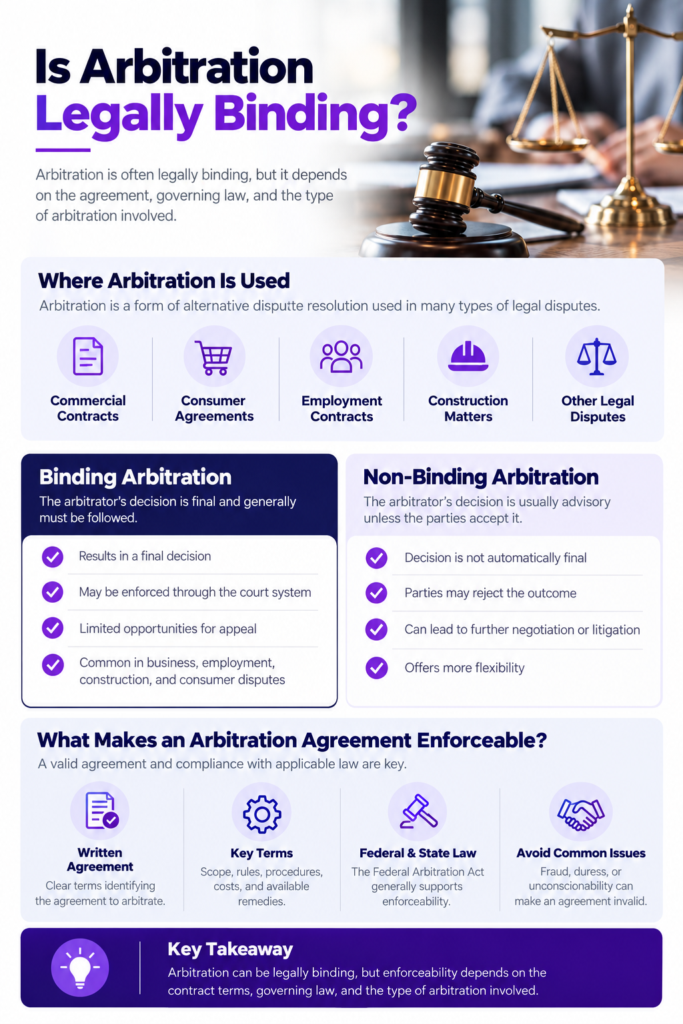
What Makes an Arbitration Agreement Enforceable?
An enforceable arbitration process usually begins with a valid arbitration agreement. Under the Federal Arbitration Act, written provisions requiring arbitration in covered transactions are generally considered valid, irrevocable, and enforceable, subject to legal or equitable grounds that could invalidate a contract. Federal law therefore gives substantial legal effect to qualifying arbitration clauses, but it does not mean every clause is automatically enforceable in every circumstance.
A clear arbitration clause should identify the parties’ agreement to arbitrate and define which disputes fall within its scope. Contract terms may also address the arbitration rules, selection of arbitrators, hearing procedures, administrative fees, discovery, confidentiality, available remedies, and location or format of proceedings. Rapid Ruling’s sample arbitration clause illustrates how parties can establish binding arbitration as their selected dispute resolution mechanism.
The Federal Arbitration Act provides the main federal framework for many arbitration agreements involving interstate commerce. State arbitration laws may also apply depending on the agreement and dispute. International arbitration can involve additional rules, including the New York Convention for recognition and enforcement of certain foreign arbitral awards. Because the applicable legal framework can vary, enforceability depends on more than simply seeing the word “arbitration” in a contract.
What Can Make an Arbitration Agreement Invalid or Unenforceable?
The question “What voids an arbitration agreement?” does not have one universal answer. Section 2 of the Federal Arbitration Act preserves generally applicable contract defenses that may affect enforceability. Depending on the facts and governing law, challenges may involve issues surrounding contract formation, fraud, duress, unconscionability, lack of mutual assent, or other defenses that would apply to contracts generally. Section 2 of the Federal Arbitration Act sets out this basic federal rule.
Certain disputes may also be treated differently under federal statutes. For example, federal law now allows a person alleging sexual assault or sexual harassment to choose whether certain predispute arbitration agreements or joint-action waivers apply to that dispute. Other statutory exclusions can also affect whether the Federal Arbitration Act governs a particular contract.
Disagreement about an arbitration clause does not automatically mean the entire contract disappears. Courts may sometimes need to decide whether a valid agreement exists, whether a particular dispute falls within its scope, or whether a legal exception applies. Because contract language and jurisdiction matter, parties considering whether they can refuse or opt out of arbitration should review the exact agreement rather than relying on a general assumption.
How Does Binding Arbitration Lead to an Enforceable Award?
The arbitration process typically begins when one party files a demand or submission under the applicable arbitration agreement and rules. Each side then has an opportunity to present its position. The process may include written statements, documentary evidence, witness testimony, limited discovery, and a hearing before a single arbitrator or an arbitration panel. Compared with a jury trial, arbitration usually has more flexible procedural rules and can be conducted privately.
The arbitrator’s role is to consider the evidence and arguments and decide the issues that the parties have submitted. Depending on the agreement and applicable law, an arbitrator’s award may include monetary damages or other remedies within the arbitrator’s authority. Rapid Ruling’s online arbitration process allows parties to submit evidence and participate remotely before receiving an arbitration award.
A final arbitration award may later be presented to a court for confirmation. Section 9 of the Federal Arbitration Act establishes a process for confirming qualifying awards when its requirements are met. Once confirmed, the award can be entered as a judgment and enforced through available legal mechanisms. That ability to convert an award into an enforceable judgment is one of the central legal consequences of binding arbitration.
Can You Sue or Appeal After Binding Arbitration?
Binding arbitration generally limits a party’s ability to take the same dispute to court after the arbitrator issues a final decision. Arbitration is intended to replace a traditional trial for claims covered by the agreement, not simply add another step before an unsuccessful party begins the case again. That is why parties should understand the effect of an arbitration clause before agreeing to it.
Appeals are also more limited than they are after ordinary litigation. Under Section 10 of the Federal Arbitration Act, a federal court can vacate a covered arbitration award on specific grounds, such as corruption, fraud, evident partiality, certain forms of misconduct, or an arbitrator exceeding the powers granted by the parties. These grounds are much narrower than simply arguing that the arbitrator interpreted evidence incorrectly.
Courts can still become involved in arbitration-related matters. A party may seek confirmation, enforcement, modification, or vacatur of an award when allowed by law. Courts may also address certain disputes about whether an arbitration agreement exists or applies. This means binding arbitration reduces traditional litigation but does not remove courts from every possible stage of the dispute resolution process.
What Should You Know Before Agreeing to Arbitration?
Before agreeing to arbitration, determine whether the clause requires binding or non-binding arbitration and whether participation is mandatory or optional. Review what disputes are covered, how the arbitrator will be chosen, how much discovery is available, what evidence can be submitted, who pays administrative and legal fees, and what remedies the arbitrator can award. Consumer and employment agreements deserve particular attention because arbitration provisions are often included in contracts signed before any dispute exists.
Arbitration has potential benefits and drawbacks. A private dispute resolution process can avoid some of the procedural complexity of courtroom litigation and may provide greater flexibility in scheduling, evidence submission, and selection of an arbitrator with relevant experience. At the same time, limited appeals, administrative fees, class action waivers, or restrictions created by the contract may affect important legal rights. The best way to evaluate an agreement is to examine its actual terms and the law governing the dispute.
There is also no reliable universal percentage for the “likelihood of winning an arbitration case.” Outcomes depend on the evidence, contract language, applicable law, credibility of testimony, available defenses, remedies requested, and facts of the particular dispute. Arbitration is a legal decision-making process, not a formula that gives one side predictable odds. Rapid Ruling provides online dispute resolution services for attorneys, businesses, and consumers seeking a structured alternative to traditional courtroom litigation.