
New York Arbitration

August 5, 2026

Share Article:

Have Any Question?

Settling disputes with our online arbitration services is easy, fast, and affordable.

We look forward to answering your questions and helping you to reach conflict resolution with our online arbitration service.

Recent Posts

focused female lawyer working on laptop at workplace in office

Understanding Dispute Resolution Clauses in Contracts

A dispute resolution clause explains how parties will handle conflicts that arise from a contract. Instead of waiting until a disagreement begins, the parties decide in advance whether they will negotiate, mediate, arbitrate, litigate, or follow several of those

Read More »
Young man standing by flipchart and giving presentation over new business startup

Advantages and Disadvantages of Arbitration

Arbitration is a form of private dispute resolution used to resolve legal and business conflicts outside a formal court process. Instead of presenting the case to a judge or jury, the parties submit evidence, documents, witness testimony, and legal arguments to a

Read More »

New York Arbitration

New York arbitration gives businesses, individuals, legal practitioners, and in-house counsel a private alternative to traditional litigation. Instead of presenting a dispute to a judge or jury, parties submit the matter to a neutral arbitrator or panel of arbitrators. The dispute resolution process can involve
Read More »

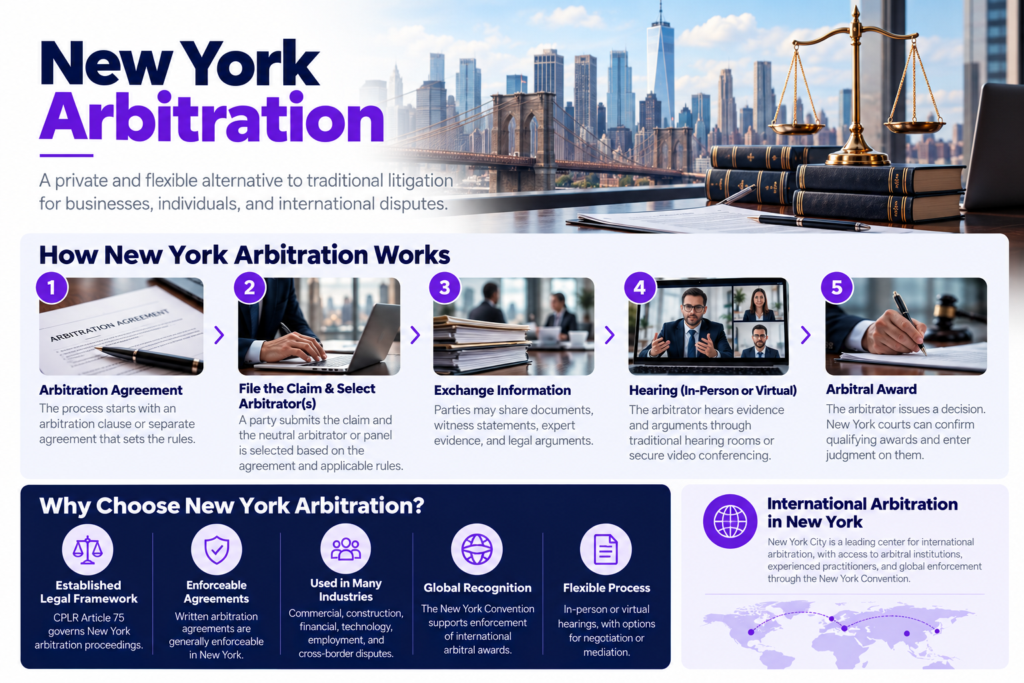
New York arbitration gives businesses, individuals, legal practitioners, and in-house counsel a private alternative to traditional litigation. Instead of presenting a dispute to a judge or jury, parties submit the matter to a neutral arbitrator or panel of arbitrators. The dispute resolution process can involve document production, witness statements, expert witness services, legal arguments, hearings, and a final arbitral award. Arbitration is commonly used for commercial disputes, cross-border contracts, investment disputes, business agreements, financial claims, technology matters, and other conflicts where an arbitration clause or separate dispute resolution clause requires or permits arbitration.

New York has a well-established legal framework for arbitration. CPLR Article 75 governs many New York arbitration proceedings, including arbitrator appointments, hearings, evidence, awards, confirmation, and applications to vacate or modify an award. Under CPLR § 7501, written arbitration agreements are generally enforceable and New York courts have authority to enforce them and enter judgment on an award. Federal law may also apply through the Federal Arbitration Act, particularly when interstate commerce is involved.

Careful drafting matters because the arbitration agreement controls much of the process. An arbitral clause may identify the governing rules, number of arbitrators, location of hearings, available remedies, confidentiality requirements, and procedures for document production. Businesses may also use model clauses when drafting contracts, but the language should match the type of dispute and commercial relationship involved.

New York City is also an important center for international arbitration. International commercial disputes may involve foreign parties, multinational agreements, simultaneous interpretation, virtual hearing rooms, and complex cross-border evidence. New York’s arbitration community includes arbitral institutions, law firms, mediators, scholars, ADR providers, and other practitioners who work with domestic and international disputes.

The United Nations Convention on the Recognition and Enforcement of Foreign Arbitral Awards, commonly called the New York Convention, plays an important role in international arbitration. The Convention requires contracting states to recognize covered arbitral awards as binding and provides a framework for enforcement of arbitral awards across national borders.

How Does the New York Arbitration Process Work?

The process usually begins with an arbitration clause or arbitration agreement. Once a dispute arises, one party submits the claim and the arbitrator or arbitration panel is selected according to the agreement and applicable rules. The case may then proceed through document production, witness statements, expert evidence, negotiation, preliminary sessions, and a final hearing. Depending on the dispute, proceedings may take place in traditional hearing rooms or through secure video conferencing and other virtual hearing technology.

Some cases may involve emergency arbitrations or requests for temporary relief before the full dispute is decided. Others may include mediation proceedings before or during arbitration if the parties want an opportunity to negotiate a settlement. Arbitration and mediation are different ADR services, but both can form part of a broader dispute resolution strategy.

After reviewing the evidence and arguments, the arbitrator issues an award. New York courts can confirm qualifying awards and enter judgment on them. Article 75 also provides limited grounds for challenging an award, while international awards may involve the New York Convention and federal law. New York City Civil Court likewise recognizes proceedings related to judicial recognition of qualifying arbitration awards under CPLR Article 75.

Rapid Ruling provides New York arbitration services through an online ADR platform. Digital case management, secure document exchange, video conferencing, and remote hearings can give parties access to structured arbitration without requiring every participant to travel to the same physical location.

Recent Posts

focused female lawyer working on laptop at workplace in office

Understanding Dispute Resolution Clauses in Contracts

A dispute resolution clause explains how parties will handle conflicts that arise from a contract. Instead of waiting until a disagreement begins, the parties decide in advance whether they will negotiate, mediate, arbitrate, litigate, or follow several of those

Read More »
Young man standing by flipchart and giving presentation over new business startup

Advantages and Disadvantages of Arbitration

Arbitration is a form of private dispute resolution used to resolve legal and business conflicts outside a formal court process. Instead of presenting the case to a judge or jury, the parties submit evidence, documents, witness testimony, and legal arguments to a

Read More »

New York Arbitration

New York arbitration gives businesses, individuals, legal practitioners, and in-house counsel a private alternative to traditional litigation. Instead of presenting a dispute to a judge or jury, parties submit the matter to a neutral arbitrator or panel of arbitrators. The dispute resolution process can involve

Read More »
Violet - Product design
Join our email list and file one claim free!*

*terms apply