

Have Any Question?
Settling disputes with our online arbitration services is easy, fast, and affordable.
We look forward to answering your questions and helping you to reach conflict resolution with our online arbitration service.
Recent Posts

I hear the same story from business owners all the time. A contractor in Florida signs a job, everything seems smooth, and then suddenly a disagreement over the contract terms pops up. Nobody wants to go to court, and most people do not want the costly
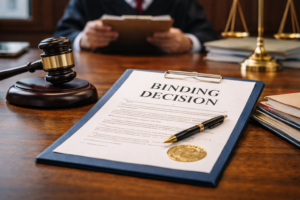
A binding decision is a ruling made by a neutral third party, such as a judge, arbitrator, or administrative body, that the parties involved must follow. In legal terms, it has the same weight as a court order. Unlike casual agreements or negotiations, a binding

Preventing Lawsuits in Joint Venture Agreements
Joint ventures (JVs) can be powerful tools for growth. Two businesses combine expertise, share resources, and expand into new markets. But for every successful real estate joint venture or international expansion, there are countless stories of deals falling apart

Arbitration Guide for Corporate Counsel and In-House Teams
For corporate counsel and in-house counsel, arbitration is no longer just an “alternative” to litigation, it’s a standard part of managing business disputes. Whether in technology, finance, real estate, or construction projects, companies increasingly rely on arbitration

Arbitration vs Mediation vs Litigation: Key Legal Differences
Imagine you’re a business owner in South Carolina who suddenly finds yourself in a heated dispute with a supplier. Do you head straight to the courthouse? Sit down with a mediator? Or let an arbitrator decide the outcome? These three pathways , arbitration,

What is Arbitration?
Arbitration is a dispute resolution technique where a neutral third party, known as an arbitrator, is appointed to make a decision after considering the evidence and arguments presented by the disputing parties. Unlike traditional litigation, arbitration is a private process, offering a more streamlined and flexible approach to resolving disputes. The arbitrator’s decision, known as an award, is final and legally binding, with limited scope for appeal.
Key Features of Arbitration
- Confidentiality: Arbitration proceedings are confidential, protecting the privacy of the parties and the details of the dispute.
- Expertise: Parties have the opportunity to select an arbitrator with specific expertise relevant to their dispute, ensuring an informed resolution.
- Flexibility: The arbitration process is more flexible than court litigation, with procedures and timelines that can be adjusted to suit the needs of the parties.
- Finality: The arbitrator’s decision is final and binding, providing a conclusive resolution to the dispute and limiting prolonged legal battles.
The Arbitration Process at Rapid Ruling
- Initiation: The arbitration process begins when a party submits a request for arbitration, outlining the dispute and the desired outcome.
- Selection of the Arbitrator: Parties choose an arbitrator from our panel of experts, selected for their knowledge and experience in specific dispute areas.
- Exchange of Information: Parties exchange relevant documents and information, ensuring a fair and informed proceeding.
- Hearing: A hearing is conducted where both parties can present their case, including evidence and witness testimony, to the arbitrator.
- Decision: The arbitrator issues a decision based on the evidence and arguments, which is final and binding on all parties.
Why Choose Rapid Ruling for Arbitration?
Rapid Ruling brings together the expertise, technology, and personalized approach necessary for effective arbitration. Our platform simplifies the arbitration process, making it accessible and straightforward for all parties involved. By choosing Rapid Ruling, you benefit from:
- Expert Arbitrators: Access to a panel of arbitrators with diverse expertise to match the specific needs of your dispute.
- Efficiency: A streamlined process designed to resolve disputes quickly and effectively, saving you time and resources.
- Flexibility: Customizable arbitration procedures to meet the unique demands of each case.
- Confidentiality: Assurance that the details of your dispute remain private.
Conclusion
Arbitration offers a practical and effective alternative to traditional court litigation, providing a path to resolution that is both expedient and equitable. With Rapid Ruling, you gain access to premier arbitration services that prioritize your needs and deliver results. Whether you’re navigating complex commercial disputes or personal conflicts, our team is here to guide you through the arbitration process with expertise and care.
Explore how Rapid Ruling’s arbitration services can help you achieve a swift and satisfactory resolution to your dispute today.
Recent Posts

I hear the same story from business owners all the time. A contractor in Florida signs a job, everything seems smooth, and then suddenly a disagreement over the contract terms pops up. Nobody wants to go to court, and most people do not want the costly

A binding decision is a ruling made by a neutral third party, such as a judge, arbitrator, or administrative body, that the parties involved must follow. In legal terms, it has the same weight as a court order. Unlike casual agreements or negotiations, a binding

Preventing Lawsuits in Joint Venture Agreements
Joint ventures (JVs) can be powerful tools for growth. Two businesses combine expertise, share resources, and expand into new markets. But for every successful real estate joint venture or international expansion, there are countless stories of deals falling apart

Arbitration Guide for Corporate Counsel and In-House Teams
For corporate counsel and in-house counsel, arbitration is no longer just an “alternative” to litigation, it’s a standard part of managing business disputes. Whether in technology, finance, real estate, or construction projects, companies increasingly rely on arbitration

Arbitration vs Mediation vs Litigation: Key Legal Differences
Imagine you’re a business owner in South Carolina who suddenly finds yourself in a heated dispute with a supplier. Do you head straight to the courthouse? Sit down with a mediator? Or let an arbitrator decide the outcome? These three pathways , arbitration,