Overview of Arbitration Agreements
A valid arbitration agreement is the cornerstone of enforceable arbitration. These agreements serve as a contract between parties, outlining the rules and procedures that govern arbitration proceedings and ensuring that disputes are resolved efficiently outside traditional civil litigation. Without a clear and comprehensive agreement, courts may hesitate to compel arbitration, and parties can face unnecessary delays or disputes over procedural compliance.
Typically, a well-drafted arbitration clause specifies the following:
- Governing Arbitration Rules: This may include rules such as AAA R-31, ICC Rules, LCIA Rules, SIAC Rules, or UNCITRAL Rules, depending on the nature of the dispute and whether it is domestic or international arbitration. These rules define the scope of evidentiary rights, Arbitration Hearing procedures, and mechanisms for issuing arbitration awards.
- Arbitration Panel Selection: Agreements should outline how the arbitration panel or arbitral tribunal is selected, including the number of arbitrators, qualifications, and procedures for replacement in the event of conflicts or withdrawals.
- Deadlines for Filings and Hearings: Clear timelines for filing fees, notice of arbitration, electronic documents, expert depositions, and the arbitration hearing itself are crucial. This ensures compliance with procedural requirements, including rules like Rule 22, Rule 23, and Rule 31, which may govern discovery, evidence presentation, or default procedures.
- Fees, Deposits, and Procedural Obligations: The agreement should address arbitration fees, arbitrator’s fees, arbitration deposits, and payment responsibilities. It may also include provisions for default sanctions in cases where a party refuses to participate or fails to comply with procedural obligations.
Beyond these essentials, an enforceable arbitration agreement should reflect key legal frameworks:
- Federal Arbitration Act (FAA): Under U.S. law, the FAA supports the enforceability of binding arbitration clauses and limits court intervention, but the FAA also allows parties to seek injunctive relief or court orders to compel arbitration when a defaulting opponent refuses to participate.
- State-Specific Statutes: Local regulations, including California statutes and New York law, may impose additional requirements for arbitration agreements, especially in employment arbitration, labor disputes, or joint ventures. The California Supreme Court has clarified that courts will generally enforce enforceable arbitration provisions, provided they are not unconscionable or outside the scope of the contract.
- International Considerations: For cross-border disputes, agreements often reference the English Arbitration Act, the United Nations Treaty, or the Convention on the Recognition and Enforcement of Foreign Arbitral Awards, ensuring international arbitration decisions are recognized and enforceable across jurisdictions. Organizations like the Chartered Institute of Arbitrators, the National Arbitration Committee, and established arbitration centers can provide guidance and oversight for such disputes.
- Procedural Safeguards: Modern agreements increasingly incorporate provisions for video conferencing, internet communication, telephonic conferences, and electronic filing to facilitate timely arbitration proceedings. Additionally, rules such as Rule 24, Rule 25, Rule 26, Rule 27, Rule 28, Rule 29, Rule 30, and Rule 32 may govern evidence presentation, subpoenas (subpoena duces tecum), and other procedural rights to maintain fairness in arbitration.
- Binding Decisions and Enforcement: A well-constructed arbitration agreement ensures that arbitration awards can be converted into a judicial decision through confirmation of the award in enforcement courts. Courts, including the US Court of Appeals, generally uphold default awards, default judgments, and ex parte decisions when a party refuses to arbitrate in compliance with the agreement.
In practice, businesses have found that including clear arbitration strategies, Arbitration Service provisions, and procedural safeguards prevents delays, preserves contract law rights, and strengthens the enforceability of binding arbitration clauses.
Ultimately, a robust arbitration agreement is more than a contract clause, it is a roadmap for the arbitration process, defining how disputes are resolved, how arbitration fees are managed, and how arbitration awards can be enforced, all while minimizing reliance on courts and protecting the parties’ interests.
Understanding Arbitration Clauses
A well-drafted arbitration clause defines the scope of disputes subject to arbitration. Common elements include:
- Binding Decision: Confirmation that the arbitrator’s decision is final
- Arbitration Panel: Number and selection process of arbitrators
- Rules and Procedures: Reference to established frameworks like ICC Rules, or LCIA Rules
In one case I handled, a technology company had a binding arbitration clause referencing UNCITRAL Rules, but the counterparty refused to acknowledge it. This required formal notice of arbitration and ultimately a court order to compel participation.
Enforcing Arbitration Agreements
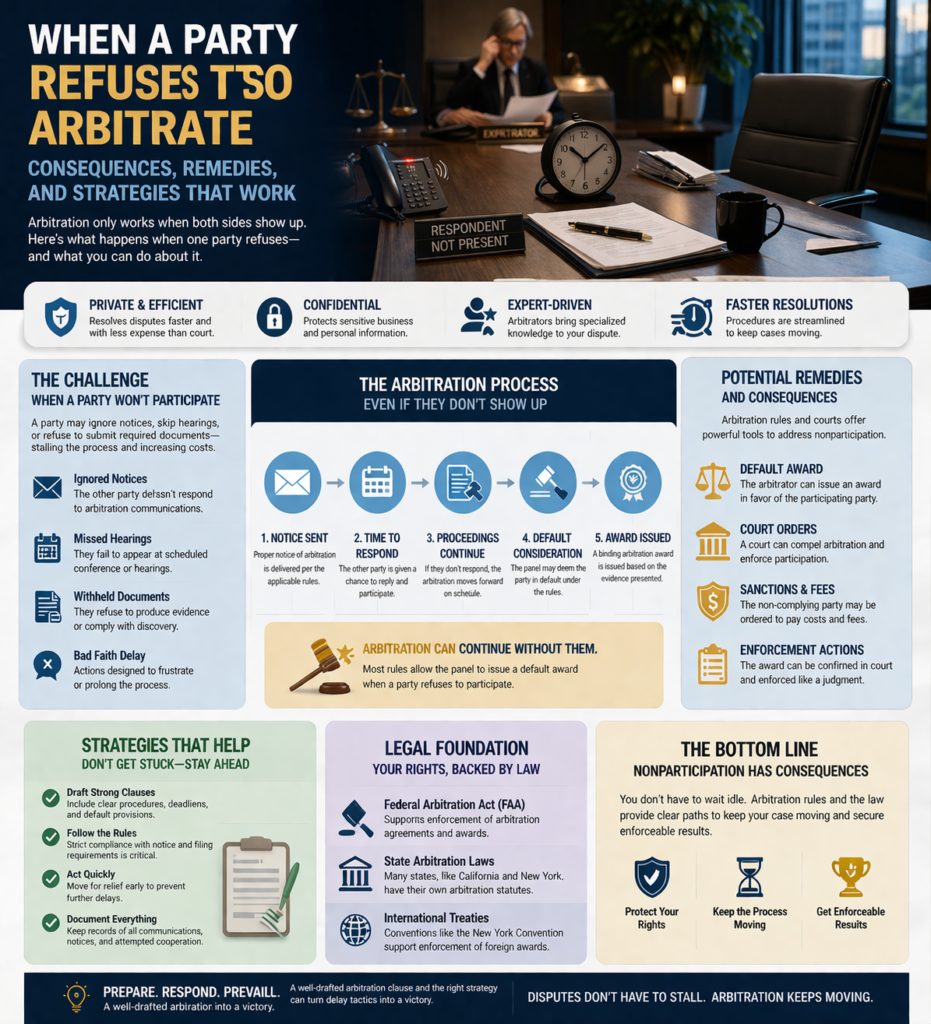
When a party refuses to participate, the first step is often a formal demand for arbitration. This usually involves:
- Sending a written notice in compliance with the arbitration provider’s rules
- Filing necessary arbitration fees and deposits
- Scheduling the arbitration hearing with an agreed panel
Compelling Arbitration through Formal Demands
Courts have consistently upheld the enforceability of arbitration agreements. In California, for example, the California Supreme Court emphasizes that arbitration clauses must be respected unless proven unconscionable or outside the contract’s scope. Remedies include:
- Motion to Compel Arbitration: Asking the court to order compliance
- Request for Injunctive Relief: Preventing ongoing harm during arbitration delays
- Default Award / Default Judgment: Allowing the arbitrator to proceed and issue an award despite nonparticipation
This aligns with the Federal Rules of Civil Procedure on motions and enforcement for federal-level disputes.
Consequences of Refusal to Arbitrate
Nonparticipation can trigger multiple consequences under standard arbitration rules:
- Default Awards: The arbitrator may issue a ruling in favor of the participating party
- Sanctions: The arbitration panel may impose financial or procedural penalties
- Court Contempt Proceedings: In cases where parties defy court orders to arbitrate
In a recent corporate dispute, the respondent ignored multiple electronic filing notifications and hearings. The arbitrator issued a default award, which the claimant later confirmed in enforcement courts as a judicial decision under the FAA.
Differentiating Between Federal and State Laws
Understanding the legal framework is critical when enforcing arbitration:
Federal Laws Governing Arbitration
- Federal Arbitration Act (FAA): Supports enforcement of arbitration clauses across states and limits judicial interference
- Convention on the Recognition and Enforcement of Foreign Arbitral Awards: Relevant for international arbitration
- Courts generally respect Binding arbitration clauses, even when one party refuses participation
State-Specific Arbitration Laws
- California statutes: Include detailed rules for employment arbitration, compulsory arbitration, and arbitrator’s fees
- New York law: Aligns closely with FAA but includes specific provisions for contract law enforcement
- State ADR offices, like the Georgia Office of Dispute Resolution, often provide guidance and local procedural standards
Challenges in Arbitration Refusal
Parties may attempt to avoid arbitration for several reasons:
- Unclear Clauses: Ambiguous language can be exploited to delay proceedings
- Claims of Unconscionability: Arguing the clause is unfair or one-sided
- Disputes Beyond Arbitration Scope: Some disputes may not fall under the signed arbitration agreement
Arbitration professionals often recommend addressing these challenges early through Arbitration Strategies and formal procedural steps.
Strategies for Initiating Arbitration Proceedings
A successful arbitration starts with preparation and clear procedural rules:
- Selecting Arbitrators: Consider subject matter expertise and impartiality
- Setting Discovery Schedules: Including expert depositions, subpoena duces tecum, and document production
- Establishing Procedural Rules: Reference rules such as Rule 24, Rule 25, Rule 28, and Rule 31 to ensure enforceability
- Technology Use: Utilize video conferencing, internet communication, and telephonic conferences for efficiency
- Electronic Filing: Maintain proper submission of electronic documents to avoid procedural delays
Alternative Dispute Resolution Options
When a party refuses to participate in arbitration proceedings, it may be necessary to explore other alternative dispute resolution (ADR) services to move the matter forward. While arbitration is often the preferred method due to its binding nature and efficiency, noncompliance can stall the arbitration process, making ADR and other strategies essential.
Mediation
Mediation provides a collaborative, facilitated environment where a neutral third party helps the disputing parties reach a mutually acceptable solution. Unlike arbitration, mediators do not issue binding arbitration awards but instead guide discussions to identify compromise solutions.
Mediation can be particularly effective when used alongside arbitration clauses because it may prevent a defaulting opponent from triggering a default award. For example, in labor disputes or joint ventures, mediation allows parties to address underlying issues without waiting for formal Arbitration Hearing procedures, potentially saving on arbitration fees and administrative costs. Additionally, mediation encourages ongoing communication, which can preserve business relationships and minimize litigation risks.
Litigation
When mediation fails or arbitration is refused, parties may need to pursue litigation to enforce their rights. Courts can compel compliance with enforceable arbitration provisions, issue a court order, or grant injunctive relief to prevent further harm. Litigation may also be necessary to confirm arbitration awards or seek a judicial decision when a party ignores procedural requirements.
While litigation is generally slower and more expensive than arbitration or mediation, it is often the only avenue when a party refuses to participate. Courts may also enforce default sanctions or hold parties in contempt proceedings for failing to comply with valid arbitration agreements.
Negotiation
Negotiation remains one of the simplest and most flexible ADR options. Informal discussions between parties can resolve disputes without triggering arbitration termination or requiring court intervention. Negotiation can help encourage participation in the arbitration process or facilitate an agreement to restructure deadlines, arbitration deposits, or procedural obligations.
Negotiation is particularly useful in disputes governed by contract law, such as employment arbitration, labor disputes, or commercial agreements, where preserving the business relationship is as important as resolving the underlying legal issue. Even in international contexts, direct negotiation can complement international arbitration frameworks like the ICC Rules, SIAC Rules, or UNCITRAL Rules, preventing unnecessary delays and maintaining flexibility.
Ultimately, these alternative dispute resolution options, mediation, litigation, and negotiation, serve as critical tools for managing disputes when one party refuses arbitration. By strategically combining these approaches, businesses and individuals can protect their rights, enforce arbitration agreements, and avoid prolonged delays in the arbitration process.
Conclusion
When a party refuses to participate in arbitration, the path forward requires a combination of arbitration rules knowledge, procedural diligence, and legal enforcement strategies. From issuing formal notices and default awards to pursuing court intervention and injunctive relief, understanding your rights under the Federal Arbitration Act, state laws, and specific provider rules is critical.
At Rapid Ruling, we guide clients through these challenges, helping enforce enforceable arbitration provisions, navigate procedural hurdles, and ensure arbitral tribunal decisions are properly recognized and confirmed. While refusal to arbitrate can be frustrating, the legal framework offers multiple tools to move forward efficiently, protect your interests, and achieve a binding resolution.