Role of the Federal Arbitration Act
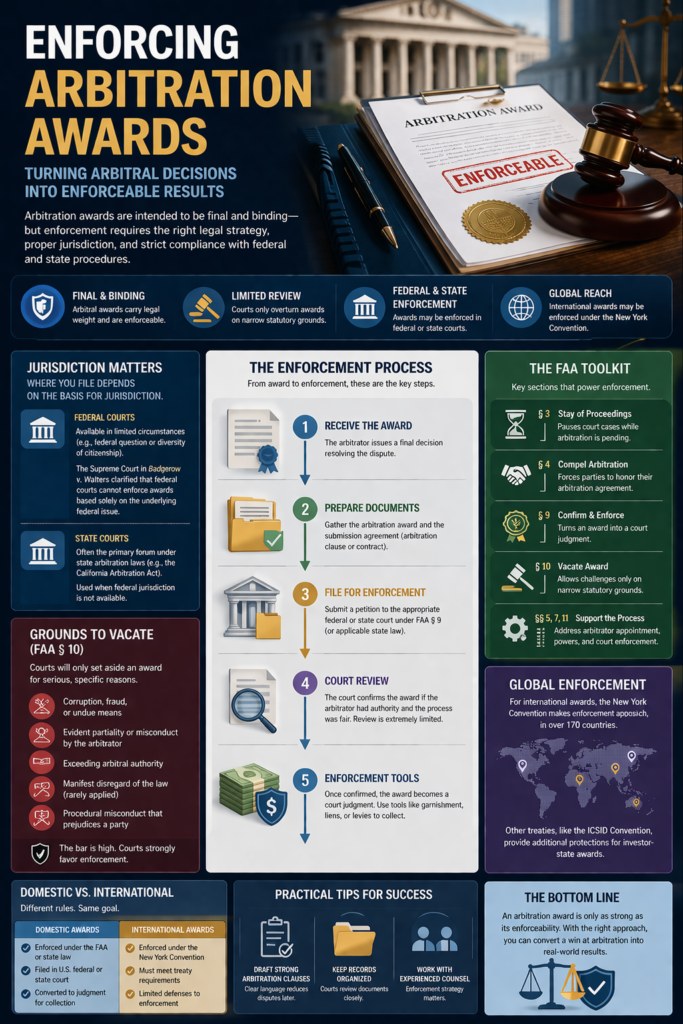
The Federal Arbitration Act (FAA) provides the primary statutory framework for enforcing arbitration agreements and arbitration awards in the United States, ensuring that parties can resolve disputes efficiently while limiting court intervention. Its provisions apply to both domestic and international arbitration, establishing clear procedures for recognition, enforcement, and vacatur of arbitral awards.
Key provisions include:
- Section 4 of the FAA – Allows parties to file a motion to compel arbitration in a federal district court when one party refuses to honor a valid arbitration clause. This provision underpins much of the arbitration process in federal courts. Learn more about Section 4.
- Section 9 of the FAA – Provides a mechanism for the recognition and enforcement of an arbitral award in court, converting it into a money judgment or other enforceable remedies. This section is frequently cited in judicial district proceedings and has been interpreted in cases like Badgerow v. Walters, which clarified limits on federal jurisdiction for enforcement. Section 9 reference.
- Section 10 of the FAA – Lists the narrow grounds for vacating an award, including corruption, fraud, or manifest disregard of law. Courts rarely overturn awards under Sections 9 and 10, emphasizing deference to arbitrators’ Findings of Fact and Conclusions of Law. Section 10 details.
- Sections 3, 5, 7, and 11 – Address procedural enforcement, including staying court proceedings while arbitration is pending, appointing arbitrators, and confirming arbitrators’ powers. These sections guide both state court and federal court approaches and are essential for complex employment disputes, commercial claims, and cross-border arbitration under the New York Convention or ICSID Convention.
U.S. federal courts generally respect arbitration agreements and arbitral awards, providing limited judicial review unless parties show clear procedural violations or statutory exceptions. Courts also consider jurisdiction carefully: enforcement often depends on federal question jurisdiction under 28 U.S.C. §1331 or diversity jurisdiction under 28 U.S.C. §1332. In contrast, state law such as the California Arbitration Act or Louisiana state court rules governs enforcement when federal jurisdiction is absent.
In practical terms, businesses and legal counsel use judgment-enforcement tools to execute awards, from garnishments to money judgments, while maintaining compliance with Federal Rules of Civil Procedure and court proceedings standards. Experienced law firms, such as Sidley Austin LLP, emphasize the importance of thorough documentation, proper service of documents, and awareness of both federal and state enforcement nuances to maximize the effectiveness of arbitral awards.
Process of Enforcing Arbitration Awards
Submission of Required Documentation
To enforce an award, parties must submit the arbitration award along with the submission agreement to the court. Courts review the award for compliance with procedural norms and ensure the arbitrator had authority under the contract.
Filing for Recognition and Enforcement
Both federal and state courts allow parties to request recognition and enforcement of arbitral awards. Federal courts handle awards when a federal law claim or diversity of citizenship provides a jurisdictional basis, while state courts enforce awards based on local statutes. The FAA provides tools for converting arbitral awards into money judgments and using judgment-enforcement tools like garnishment or liens.
Handling Partial and Interim Awards
Courts may enforce partial awards or interim awards to preserve contractual rights, especially in complex commercial disputes or employment arbitration scenarios.
Grounds for Setting Aside Arbitration Awards
While arbitral awards are generally final and binding, parties may seek to vacate or set aside an award under Section 10 of the Federal Arbitration Act (FAA) for very specific and narrowly defined reasons. The United States courts maintain a strong presumption in favor of enforcement, emphasizing deference to the arbitration process and arbitrators’ Findings of Fact and Conclusions of Law.
Common grounds for vacatur include:
- Manifest disregard of law – This occurs when an arbitrator intentionally ignores applicable legal principles or the clear meaning of the law, undermining the fairness of the arbitral award. Courts, including federal district courts, are cautious when applying this standard, as seen in precedents such as Lucent Technologies, Inc. v. Lucent Techs. Inc.
- Arbitrator corruption or fraud – Awards can be vacated if the arbitrator engaged in corrupt practices, bribery, or fraudulent behavior, including tampering with submission agreements or evidence. Such misconduct is strictly scrutinized by state courts and federal courts alike.
- Procedural irregularities – Parties may challenge awards if there were serious procedural errors that compromised due process, including failure to provide proper notice, improper service of documents, or exceeding authority granted under the arbitration clause or submission agreement.
The grounds under Sections 9 and 10 of the FAA are intentionally narrow, reflecting the policy favoring finality in arbitration and the limited role of courts in second-guessing arbitrators’ business decisions. Courts often defer to arbitral findings, even in complex commercial disputes or employment arbitration, unless one of the statutory exceptions is clearly met.
International Arbitration and Enforcement
Enforcing foreign awards introduces additional layers. The New York Convention allows U.S. courts to recognize awards from signatory countries. Other instruments include:
- ICSID Convention – For investment treaty awards
- Panama Convention – Enforcement in the Americas
- Hague Convention – Specialized international dispute contexts
Compliance with these conventions is crucial, particularly when parties operate across jurisdictions or involve sovereign entities protected under the Foreign Sovereign Immunities Act. Businesses must also consider economic and trade sanctions, including Blocking sanctions and general licenses administered by the Office of Foreign Assets Control.
State vs. Federal Court Enforcement
Historically, federal courts played a central role in enforcing arbitration awards. However, after Badgerow v. Walters, courts clarified that federal courts cannot confirm or vacate awards solely due to a federal-question suit. As a result, many parties now rely on state courts for enforcement under state arbitration statutes.
State courts in Louisiana, California, and other jurisdictions have well-established mechanisms to enforce domestic and international arbitral awards, often faster than federal district courts while maintaining similar procedural protections.
Practical Considerations for Businesses
For businesses navigating the enforcement of arbitration awards, careful planning and understanding of both federal and state law are essential. The success of enforcement often depends on strategic attention to the arbitration process, proper documentation, and awareness of potential legal challenges.
Key considerations include:
- Arbitration clause in the original contract – The enforceability of an arbitral award begins with the drafting of a clear arbitration clause or dispute resolution clause. Well-drafted clauses define the arbitration organization, procedures, and rules governing the award. The Federal Arbitration Act and state law, such as the California Arbitration Act, provide guidance on how courts interpret these clauses.
- Nature of the award (domestic or international) – Enforcement differs depending on whether the award arises from a U.S. arbitration or an international arbitration governed by conventions like the New York Convention, ICSID Convention, or Hague Convention. For international awards, businesses must consider sovereign immunity, economic and trade sanctions, and compliance with the Foreign Sovereign Immunities Act.
- Proper documentation and service of documents – Accurate filing in the correct federal district court or state court is critical, alongside timely and verified service of documents to all parties. Courts reviewing Sections 9 and 10 of the FAA focus heavily on adherence to procedural rules to maintain the integrity of the arbitration process.
- Potential grounds for vacatur or modification – Businesses should assess the likelihood that a party may attempt to vacate an arbitral award under Section 10 of the FAA for reasons such as manifest disregard of law, fraud, or procedural irregularities. Evaluating these risks early helps in preparing a strong enforcement strategy.
- Consulting experienced legal counsel – Partnering with attorneys knowledgeable in arbitration law, such as those familiar with Sidley Austin LLP practices or comparable firms, ensures proper navigation of federal courts, state law, and international enforcement frameworks. Counsel can advise on jurisdictional strategy, filing requirements, and coordination with judgment-enforcement tools to protect business interests effectively.
By proactively addressing these practical considerations, businesses can minimize delays, reduce the risk of vacatur, and streamline the recognition and enforcement of both domestic and international arbitral awards.
Influence of Judicial Decisions on Enforcement
Courts increasingly apply a look through approach to assess jurisdiction, evaluating the underlying dispute rather than the mere existence of a federal issue. Key precedents like Vaden v. Discover Bank and Badgerow v. Walters illustrate the careful balance between deference to arbitration and judicial oversight.
Federal Circuit Courts of Appeal continue to clarify limits on federal jurisdiction, while state courts remain active participants in enforcing arbitration awards under both domestic and international conventions.
Conclusion: Balancing Deference and Judicial Intervention
Enforcing arbitration awards in the United States requires careful attention to federal courts, state law, and applicable international conventions. By understanding the Federal Arbitration Act, jurisdictional nuances, and procedural requirements, businesses can effectively transform an arbitral award into an enforceable judgment.
With proper preparation and legal guidance, arbitration remains a powerful mechanism for resolving disputes, ensuring contractual obligations are respected, and protecting business interests domestically and internationally.