Commercial Lease Disputes: Common Causes and Resolution Options

December 19, 2025

Share Article:

Have Any Question?

Settling disputes with our online arbitration services is easy, fast, and affordable.

We look forward to answering your questions and helping you to reach conflict resolution with our online arbitration service.

Recent Posts

What Is an Arbitration Agreement? A Clear Legal Guide

If you’ve ever signed a cell phone contract, started a new job, or signed paperwork for a gym membership in places like Long Island, Manhattan, or Queens, chances are you agreed to something you barely noticed in the fine print: an arbitration agreement.

Read More »

Handling Non-Compete Violations Without Going to Court

A non-compete agreement is a type of restrictive covenant commonly found in an employment contract. Employers often require employees to sign these contracts to prevent job hopping, safeguard trade secrets, and protect client relationships. At their core,

Read More »
Table of Contents

Common Causes of Commercial Lease Disagreements

Commercial lease disputes are common in real estate and can create significant financial and legal challenges for both commercial landlords and tenants. Conflicts often stem from disagreements over lease terms, non-payment of rent, or responsibilities tied to property maintenance. Rent disputes may arise over rent increases, escalation clauses, or arrears in rent payments. Other common issues include HVAC systems, service charge allocations, or unclear lease provisions. Beyond financial conflicts, commercial property disputes also extend to property boundaries, zoning violations, and construction disputes that affect the tenant’s ability to operate. Understanding these causes is the first step toward effective dispute resolution.

Rent and Service Charge Disputes

One of the most frequent commercial lease disputes involves rent. Tenants may challenge rent increases or claim that service charges for shared spaces are excessive or improperly calculated. Landlords may respond with eviction procedures if tenants fail to meet their rent obligations. Disputes can also arise over ground leases or leasehold estates where responsibility for insurance, property taxes, or repairs is unclear. Addressing rent disputes early, with reference to the lease agreement and standard clauses, can prevent costly legal action.

Commercial real estate disputes often extend to physical property boundaries, easements, and access rights. When lease terms are unclear, conflicts over parking, deliveries, or property development can escalate. Similarly, disputes over maintenance responsibilities, such as HVAC systems, roof repairs, or structural components, can strain business relationships. Lease drafting should specify which party is responsible for routine property maintenance, repairs, and compliance with zoning regulations.

Why Avoiding Litigation Matters

Court involvement in commercial lease disputes is often the most expensive and time-consuming route. Civil litigation exposes both parties to court costs, attorney fees, and drawn-out court proceedings. Commercial landlords and tenants may also face reputational risks if their dispute becomes part of public court records. Because long-term business relationships are often at stake, informal dispute resolution, mediation sessions, or arbitration provide more efficient, confidential alternatives. According to the American Arbitration Association (AAA), Alternative Dispute Resolution (ADR) methods save time and preserve business relationships by avoiding adversarial litigation.

Negotiation as the First Step

Most lease disputes can be resolved through direct negotiation. Clear communication strategies, such as documented emails, scheduled meetings, and acknowledgment of both parties’ interests, help achieve amicable solutions. Negotiation allows flexibility to adjust payment plans, clarify ambiguous lease provisions, or settle boundary disputes without court proceedings. Business owners benefit from maintaining control over the outcome instead of leaving decisions to a judge.

Mediation and Arbitration Options

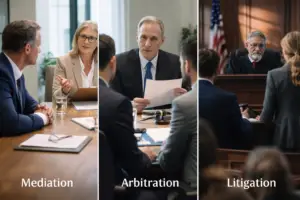
When negotiation fails, mediation service providers offer neutral forums for resolving disputes. In mediation sessions, a neutral third party helps both sides explore solutions without imposing a decision. Mediation is non-binding but often results in written agreements that preserve business relationships. Arbitration, by contrast, is a binding process where an arbitrator issues a decision enforceable like a court judgment. Many lease agreements now include dispute resolution clauses requiring parties to attempt mediation or arbitration before litigation. Organizations such as Rapid Ruling and the AAA provide commercial lease dispute resolution programs with experienced mediators and arbitrators.

Key Lease Clauses to Minimize Disputes

Well-drafted lease agreements can significantly reduce the likelihood of disputes. Important provisions include:

  • Rent escalation clauses: Clearly defining how and when rent can increase.
  • Maintenance obligations: Identifying responsibility for HVAC systems, structural repairs, and property upkeep.
  • Dispute resolution clauses: Requiring informal dispute resolution, mediation, or arbitration before legal action.
  • Termination rights: Explaining procedures for eviction disputes and vacant possession.

Including these clauses provides contractual certainty and reduces the risk of future litigation.

Tenant and Landlord Rights in Lease Disputes

Commercial landlords and tenants both have defined legal rights in lease disputes.

  • Tenants’ rights: To occupy the premises, receive necessary maintenance, and enforce lease provisions against unfair rent increases or zoning violations.
  • Landlords’ rights: To receive timely rent payments, enforce lease drafting provisions, and pursue eviction procedures when tenants breach the lease agreement.
    Rights vary across jurisdictions. For example, California courts apply specific real estate statutes. Regulatory bodies and compliance frameworks further shape enforcement actions depending on location.

Legal Remedies and Enforcement Actions

If ADR fails, parties may resort to court proceedings. Legal remedies include claims for unpaid rent, applications for vacant possession, or enforcement of lease terms through court orders. Commercial landlords may also seek damages for non-payment of rent, while tenants may counterclaim for property maintenance failures or zoning disputes. Enforcement actions are costly, but sometimes necessary when business relationships fully deteriorate.

The Benefits of Alternative Dispute Resolution

Ultimately, Alternative Dispute Resolution methods, negotiation, mediation, and arbitration, offer significant advantages over litigation.

  • Cost-effective: Avoids attorney fees and court costs.
  • Faster resolution: ADR proceedings are often completed within weeks or months.
  • Confidentiality: Keeps sensitive business disputes out of the public eye.
  • Preserves relationships: Supports ongoing landlord-tenant business partnerships.

By incorporating dispute resolution clauses into lease agreements, commercial landlords and tenants can prevent protracted disputes and ensure conflicts are resolved in a structured, efficient manner.

Conclusion

Commercial lease disputes can arise from rent arrears, unclear lease provisions, property boundaries, or maintenance responsibilities. While court involvement remains a last resort, alternatives such as negotiation, mediation, and arbitration often achieve better outcomes. By prioritizing clear lease drafting, proactive communication, and ADR methods, businesses can reduce risks, control costs, and maintain valuable business relationships.

Recent Posts

What Is an Arbitration Agreement? A Clear Legal Guide

If you’ve ever signed a cell phone contract, started a new job, or signed paperwork for a gym membership in places like Long Island, Manhattan, or Queens, chances are you agreed to something you barely noticed in the fine print: an arbitration agreement.

Read More »

Handling Non-Compete Violations Without Going to Court

A non-compete agreement is a type of restrictive covenant commonly found in an employment contract. Employers often require employees to sign these contracts to prevent job hopping, safeguard trade secrets, and protect client relationships. At their core,

Read More »
Violet - Product design
Join our email list and file one claim free!*

*terms apply