Online Arbitration vs. Traditional Arbitration
Traditional arbitration and online arbitration share the same foundation. Both use a neutral arbitrator instead of a judge or jury. Both allow parties to present evidence. Both may include an arbitration hearing. Both may result in a binding arbitral award. The main difference is how the process is delivered.
Traditional arbitration usually happens in person. The parties may meet in a conference room, law office, arbitration center, or hearing facility. This can work well for complex disputes, but it may also create practical challenges. Travel, scheduling, attorney availability, physical documents, and room rentals can all increase costs and slow the process down.
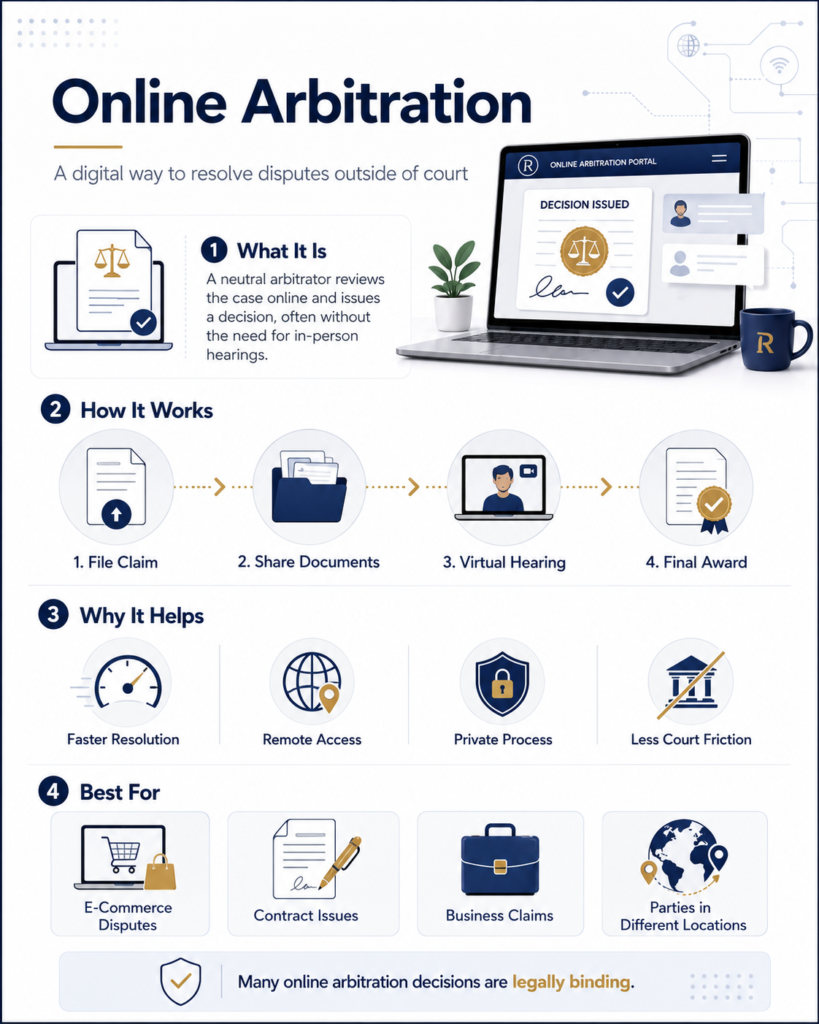
Online arbitration removes many of those barriers. Parties can submit evidence digitally, communicate through correspondence online, attend virtual meetings, and participate from different locations. This is especially useful for electronic commerce, online service agreements, remote business relationships, e-commerce refund disputes, and cross-border e-commerce disputes where the parties may never have met in person.
Online arbitration may also support hybrid hearings. A hybrid hearing allows some participants to appear in person while others join remotely. This can be helpful when a witness, attorney, expert, or business representative cannot attend physically. Hybrid hearings give the arbitral process more flexibility while still preserving structure.
However, online arbitration is not always the best choice for every case. Some disputes may involve complex witness credibility issues, physical evidence, major damages, class action waivers, or legal rights that require careful review. The biggest problem of arbitration is often not whether it happens online or in person. The bigger issue is whether the parties understand the rules, fees, finality, and judicial review standards before agreeing to the process.
Benefits of Online Arbitration
One of the biggest benefits of online arbitration is speed. Court disputes can move slowly because of crowded calendars, procedural filings, discovery disputes, and hearing delays. Online arbitration is often designed for faster communication and Fast-Track Proceedings. Parties can upload evidence, receive automatic notifications, schedule virtual hearings, and move through the dispute resolution process without waiting for every step to happen in person.
Cost is another major advantage. Court fees, attorneys’ fees, travel costs, printing costs, and time away from work can make traditional litigation expensive. Online arbitration may still involve arbitration fees, platform fees, or a Fees Calculator, but it can reduce many of the expenses tied to court and in-person hearings. For Micro Claims or lower-value disputes, online arbitration may offer a more realistic path than filing in small claims court.
Accessibility is also important. Online arbitration can help people resolve disputes across cities, states, or countries. This matters for businesses that sell products or services online, manage customers in multiple markets, or handle Global Management Of Customers’ Complaints. It can also help consumers and businesses who need a practical way to resolve disputes without traveling or navigating a complicated courthouse process.
Confidentiality is another reason parties use online arbitration. Court filings are often public, but arbitration can be handled in a more private setting. Secure document submissions, confidential file-sharing, and controlled access to case materials can help protect sensitive financial transactions, business records, customer information, and contract details.
Technology is also changing how disputes are resolved. Artificial Intelligence, automated negotiation, Information and Communication Technology, and other digital communication tools are shaping the future of ODR Sites and online arbitration platforms. While AI should not replace a fair neutral decision-maker in serious disputes, it can help organize information, route claims, support settlement of disputes, and make online case management more efficient.
Legal Frameworks and Enforceability
Online arbitration can be legally binding when the parties have agreed to binding arbitration and the process follows the applicable legal framework. The fact that the hearing happens online does not automatically make the award weaker. What matters is whether there is a valid arbitration agreement, fair notice, a reasonable opportunity to present evidence, and compliance with the rules governing the arbitration.
In the United States, many arbitration agreements are governed by the Federal Arbitration Act. State and federal courts often enforce valid arbitration agreements and may confirm arbitration awards when the legal requirements are met. However, judicial review standards are usually limited. That means a court generally does not re-try the entire case just because one side disagrees with the result.
International online arbitration may involve additional rules and legal frameworks. The New York Convention is important in cross-border arbitration because it helps support recognition and enforcement of foreign arbitral awards in many countries. Other frameworks and guidance, such as the UNCITRAL Technical Notes on Online Dispute Resolution, EU Electronic Commerce Law, the European Small Claims Procedure, the Swiss Code on Private International Law, and the arbitration Act of 1996 in the United Kingdom, may be relevant depending on where the parties are located and what laws apply.
Several organizations and institutions have also shaped online arbitration and digital dispute resolution. These include the WIPO Arbitration and Mediation Center, the Saudi Center for Commercial Arbitration and SCCA platform, the SCCA Court, JAMS Institute, and other ADR entities. Some consumer and policy discussions also involve groups such as the Consumer Financial Protection Bureau, Federal Trade Commission, Transatlantic Consumer Dialogue, Canadian Working Group on Electronic Commerce and Consumers, and academic institutions that study technology’s impact on dispute resolution.
The key takeaway is that online arbitration is not just a video call with a decision at the end. When properly structured, it can be part of a recognized legal process with enforceable outcomes. Parties should still review the arbitration clause, rules, fees, venue, governing law, and appeal limitations before starting.
When Online Arbitration May Be the Right Choice
Online arbitration may be a strong option when parties want a faster, more flexible, and more practical way to resolve disputes. It is especially useful for contract breach disputes, e-commerce disputes, online service disagreements, unpaid invoices, consumer arbitration, B2B disputes, B2C ODR claims, and lower-value monetary claims where full litigation may not make financial sense.
It may also be helpful when the parties are located in different places. A business in one state may have a dispute with a customer, vendor, or contractor in another. An online seller may need to resolve an e-commerce refund dispute with a buyer in a different country. A company may need to handle customer complaints at scale without sending every case into court. In these situations, online arbitration can provide resolution without the roadblocks of traditional litigation.
Online arbitration can also help preserve business relationships. Court disputes often feel adversarial and public. A private online process gives both sides a structured way to be heard without immediately escalating the conflict into a lengthy lawsuit. For startups, small businesses, service providers, and online merchants, that balance can be valuable.
Still, parties should choose carefully. Online arbitration works best when the platform is secure, the rules are clear, the arbitrator is neutral, and the process gives each side a fair opportunity to present its case. The best systems combine digital convenience with real procedural fairness.
For many modern disputes, online arbitration offers a practical middle ground. It is more formal than a customer service complaint or informal negotiation, but often faster and less burdensome than court. With the right ODR platform, clear rules, and a fair arbitrator, online arbitration can help parties move from conflict to resolution with greater speed, privacy, and confidence.