What Is Binding Arbitration?
May 1, 2026
Share Article:
Settling disputes with our online arbitration services is easy, fast, and affordable.
We look forward to answering your questions and helping you to reach conflict resolution with our online arbitration service.

Online arbitration is a digital form of alternative dispute resolution where parties resolve a dispute through an arbitrator without needing to appear in a physical courtroom or hearing room. Instead of managing every step in person, the process

Binding arbitration is a private dispute resolution process where two or more parties agree to present their case to a neutral third party, known as an arbitrator, instead of going through a traditional court trial. After reviewing the evidence, listening to

Arbitration is widely used to resolve disputes outside of traditional courtrooms. While it offers speed and confidentiality, parties often wonder if an arbitrator’s award can ever be overturned. Understanding the legal framework, judicial review standards, and practical challenges is essential for anyone

What Happens When One Party Refuses to Participate in Arbitration
Arbitration is often touted as a faster, more efficient alternative to traditional court litigation. Yet, even with a clear arbitration agreement in place, disputes can stall when one party simply refuses to participate. I’ve seen this firsthand working with businesses navigating complex dispute resolution

How Arbitration Awards Are Enforced in State and Federal Courts
Arbitration awards can resolve disputes efficiently, but their enforceability depends on navigating complex federal and state procedures. Whether a business is enforcing a domestic award in a U.S. federal court or an international arbitral award under the New
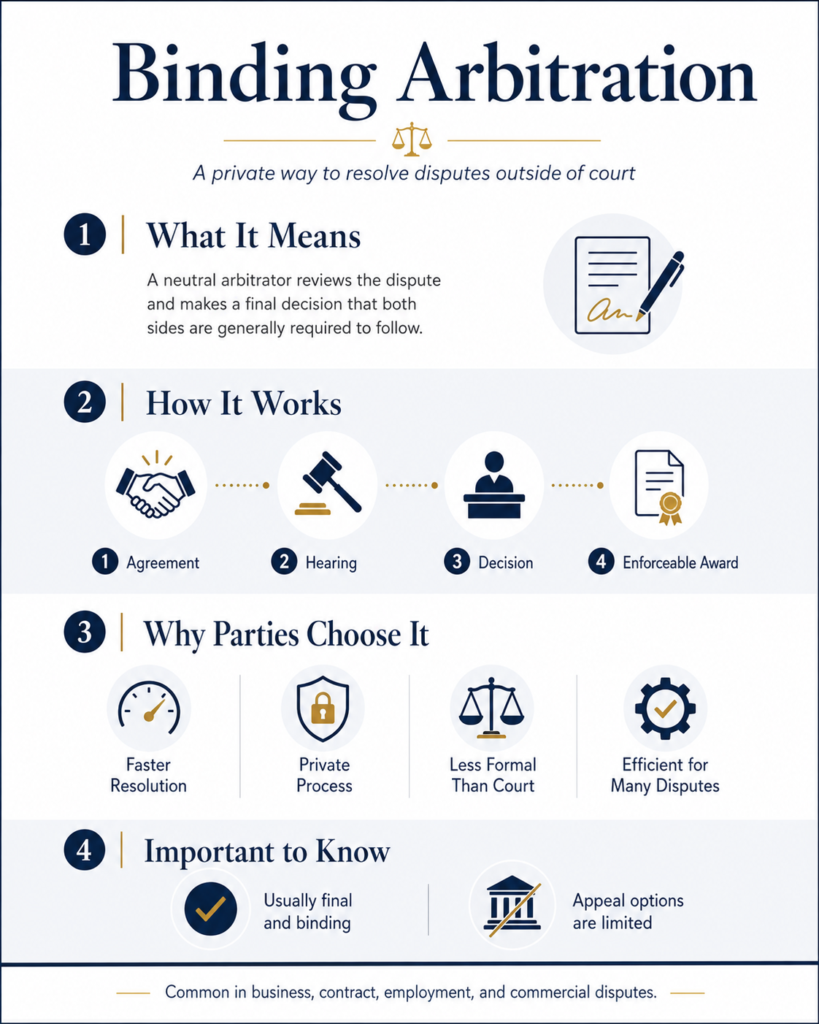
Binding arbitration is a private dispute resolution process where two or more parties agree to present their case to a neutral third party, known as an arbitrator, instead of going through a traditional court trial. After reviewing the evidence, listening to arguments, and applying the relevant contract terms or legal standards, the arbitrator issues a final decision called an arbitration award. In binding arbitration, that award is typically enforceable and the parties are expected to follow it.
For businesses, professionals, and individuals involved in a legal dispute, binding arbitration can offer a more focused and efficient path than civil litigation. It is commonly used in commercial contracts, employment agreements, consumer agreements, construction disputes, financial services, and other matters where parties want a structured decision without the time and expense of a full court proceeding. The American Arbitration Association describes arbitration as a private, legally binding form of alternative dispute resolution where neutral arbitrators resolve disputes outside of court.
How Binding Arbitration Works
The arbitration process usually begins with an arbitration agreement or arbitration clause. This clause may already be written into a contract, or the parties may agree to arbitration after a dispute arises. Once arbitration is started, the parties select an arbitrator or follow the rules of an arbitration body that appoints one. In some cases, a panel of arbitrators may be used, especially for larger commercial disputes.
After the arbitrator is selected, each side has an opportunity to present its claim, response, evidence, and legal arguments. The process may include document exchange, limited discovery, witness statements, written submissions, and an arbitration hearing. An arbitration hearing can feel similar to a trial, but it is usually less formal. The parties may still have attorneys, present evidence, question witnesses, and explain why they believe the arbitrator should rule in their favor.
Once the arbitrator reviews the information, they issue an arbitration award. In binding arbitration, that award is not simply a recommendation. It is the final decision in the dispute. The American Bar Association explains that arbitration often involves opening statements, evidence, and arguments in a process that resembles a trial, but it usually operates outside the public court system.
Binding Arbitration Agreements and Contract Clauses
A binding arbitration agreement is the legal foundation that gives the arbitrator authority to decide the dispute. This agreement may appear as a standalone document or as a small arbitration clause inside a larger contract. Many people encounter arbitration clauses in business contracts, employment agreements, service agreements, real estate contracts, software terms, financial agreements, and consumer purchase documents.
The wording of the arbitration clause matters. It may explain what types of disputes must go to arbitration, which arbitration rules apply, how the arbitrator is selected, where the arbitration takes place, who pays arbitration fees, and whether attorney fees may be awarded. Some clauses also state whether the arbitration is confidential, whether class actions are waived, or whether the arbitrator can award certain types of damages.
Because binding arbitration can limit the right to bring a lawsuit or have a jury trial, parties should read arbitration clauses carefully before signing. The Federal Arbitration Act, found in Title 9 of the U.S. Code, provides a legal framework for enforcing arbitration agreements and arbitration awards in many disputes involving commerce.
Benefits and Drawbacks of Binding Arbitration
One of the biggest benefits of binding arbitration is efficiency. Court litigation can take months or years, especially when discovery, motions, scheduling conflicts, and appeals stretch the timeline. Arbitration is often designed to move faster. This can help parties resolve disputes sooner and return their attention to business, work, or personal priorities.
Binding arbitration can also be more private than court. Court filings and hearings are often public, while arbitration proceedings are commonly handled in a confidential setting. For companies, professionals, and individuals who want to avoid public exposure of sensitive contract terms, financial records, customer issues, or internal disputes, privacy can be a major advantage.
Cost is another reason parties choose arbitration. While arbitration is not always inexpensive, it can reduce some of the expenses tied to extended litigation. A more streamlined process may limit prolonged discovery, repeated court appearances, and drawn-out procedural battles. However, arbitration fees, arbitrator compensation, administrative costs, and attorney fees can still add up, depending on the complexity of the dispute.
The main drawback is limited appeal rights. In court, a party may have more opportunities to challenge a decision. In binding arbitration, the award is generally final, and court review is narrow. That finality can be valuable when parties want closure, but it can feel risky if one side believes the arbitrator made a mistake. Binding arbitration may also raise concerns when one party has more bargaining power, such as in mandatory employment or consumer agreements.
Binding Arbitration vs. Non-Binding Arbitration
The difference between binding and non-binding arbitration comes down to the effect of the arbitrator’s decision. In binding arbitration, the arbitration award is final and enforceable. The parties are usually required to comply with the decision, and if one side refuses, the other may be able to ask a court to confirm and enforce the award.
Non-binding arbitration works differently. The arbitrator still hears the dispute and issues a decision, but that decision is usually advisory. If one or both parties reject the outcome, the dispute may continue into litigation or another resolution process. Non-binding arbitration can be useful when parties want an informed neutral evaluation before deciding whether to settle or proceed further.
For many commercial and contract disputes, binding arbitration is preferred because it creates a clear endpoint. The parties agree in advance that the arbitrator’s decision will resolve the matter. For disputes where parties want flexibility, or where they are not ready to give up access to court, non-binding arbitration may be a better fit.
When Binding Arbitration May Be the Right Path
Binding arbitration may be a strong option when parties want a final decision without the full burden of court litigation. It can be especially useful when the dispute involves a contract, unpaid invoice, business disagreement, service issue, partnership conflict, or commercial claim where both sides benefit from a faster and more private process.
It may also be appropriate when the parties want an arbitrator with subject matter experience. In court, a judge or jury may not have deep knowledge of a specific industry. In arbitration, parties often have more input in selecting a neutral with experience in business, construction, employment, finance, technology, or another relevant area.
Still, binding arbitration should not be treated as a casual decision. Before agreeing to arbitration, parties should understand the arbitration agreement, the costs, the rules, the selection process, and the finality of the award. When used properly, binding arbitration can provide a practical path to resolution. It gives parties structure, privacy, and closure while avoiding many of the delays that can come with traditional court proceedings.
For anyone facing a dispute, the key question is not simply whether arbitration is “good” or “bad.” The better question is whether binding arbitration fits the specific dispute, contract, relationship, and desired outcome. When the process is clearly understood, it can be a powerful tool for resolving conflict with greater speed and certainty.
Recent Posts

Online arbitration is a digital form of alternative dispute resolution where parties resolve a dispute through an arbitrator without needing to appear in a physical courtroom or hearing room. Instead of managing every step in person, the process

Binding arbitration is a private dispute resolution process where two or more parties agree to present their case to a neutral third party, known as an arbitrator, instead of going through a traditional court trial. After reviewing the evidence, listening to

Arbitration is widely used to resolve disputes outside of traditional courtrooms. While it offers speed and confidentiality, parties often wonder if an arbitrator’s award can ever be overturned. Understanding the legal framework, judicial review standards, and practical challenges is essential for anyone

What Happens When One Party Refuses to Participate in Arbitration
Arbitration is often touted as a faster, more efficient alternative to traditional court litigation. Yet, even with a clear arbitration agreement in place, disputes can stall when one party simply refuses to participate. I’ve seen this firsthand working with businesses navigating complex dispute resolution

How Arbitration Awards Are Enforced in State and Federal Courts
Arbitration awards can resolve disputes efficiently, but their enforceability depends on navigating complex federal and state procedures. Whether a business is enforcing a domestic award in a U.S. federal court or an international arbitral award under the New