Legal Framework for Overturning Arbitration
Federal Arbitration Act and Key Provisions
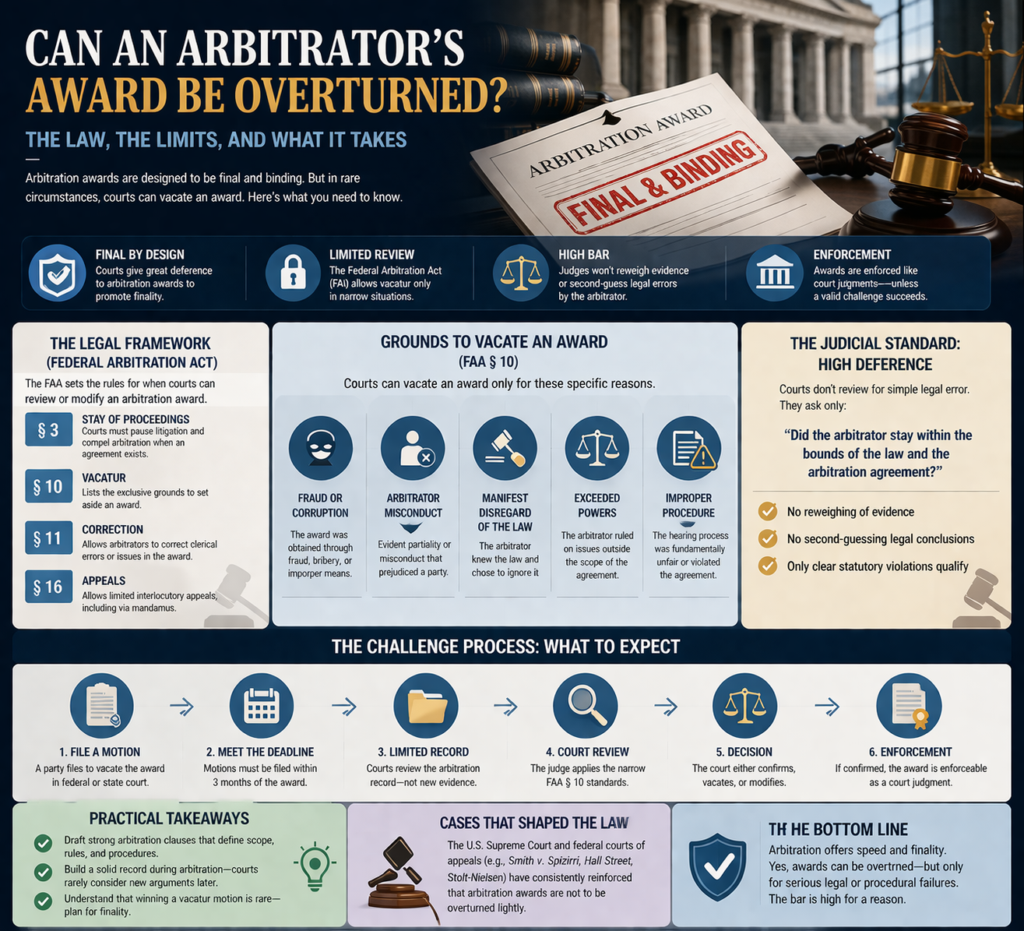
The Federal Arbitration Act (FAA) provides the statutory framework for reviewing and potentially vacating an arbitrator’s award in the United States. It establishes clear procedures for parties seeking judicial intervention while emphasizing the finality of arbitral awards. Key sections of the FAA include:
- Section 3 – Grants federal courts the authority to stay court proceedings in favor of arbitration when an arbitration agreement exists. This ensures that disputes are first resolved through the arbitration process unless specific exceptions apply.
- Section 10 – Outlines narrow grounds for vacating an arbitration decision, such as fraud, arbitrator misconduct, or manifest disregard of law. Courts rarely overturn awards absent these circumstances.
- Section 11 – Confers authority to correct clerical errors or minor discrepancies in arbitration awards, allowing arbitrators to adjust their Findings of Fact or Conclusions of Law without reopening the entire proceeding.
- Section 16(b)(1) & (b)(2) – Defines the appeals process and permits limited interlocutory appeals, including writs of mandamus, from decisions enforcing or vacating awards in federal district courts.
Courts, including federal courts and district courts, show considerable deference to the panel of arbitrators, respecting both the procedural and substantive findings unless clear violations of law or public policy exist. The FAA also interacts with state law, including the California Arbitration Act, CPLR 7511 in New York, and the Maryland Arbitration Act, when cases involve arbitration provisions or consumer arbitration agreements.
Supreme Court Guidance
The Supreme Court has repeatedly clarified the high threshold required to vacate an arbitrator’s award. In cases such as Smith v. Spizzirri, the Court reinforced that judicial review is limited and that federal law strongly favors enforcement of arbitration clauses. Even Federal Circuit Courts of Appeal, including the Ninth Circuit and Eleventh Circuit, have echoed this standard, only permitting vacatur for statutory reasons such as fraud, manifest disregard of law, or arbitrator bias.
These rulings also influence how courts handle interlocutory appeals, automatic stays, and the enforcement of arbitration awards across construction projects, brokerage agreements, and employment disputes. Examples from practice, such as Piggly Wiggly Operators’ Warehouse, MCI Constructors, and Homewood Suites Hotel cases, illustrate the limited circumstances under which courts will intervene.
Practical Implications
For parties involved in an arbitration proceeding, understanding the FAA’s framework is critical for both dispute resolution strategy and risk management. Key considerations include:
- The scope of the arbitration clause in the original contract or submission agreement.
- Statutory limitations such as the statute of limitations and notice provisions.
- Potential financial harm or legal consequences if an award is vacated or corrected.
- The choice of arbitration provider, including FINRA arbitration, AAA, or private ADR firms, which can influence the application of procedural rules.
Courts strive to balance deference to arbitrators with protecting parties from misconduct or fundamental unfairness, reinforcing the role of arbitration agreements as a reliable dispute resolution mechanism.
Challenges in Overturning Arbitration Decisions
Limited Grounds for Vacatur
Courts recognize only a few valid grounds for setting aside arbitration decisions, including:
- Manifest disregard of law – occurs when arbitrators knowingly ignore binding legal principles. The Federal Arbitration Act (FAA) §10 outlines this as a basis for vacating awards.
- Fraud or corruption – misconduct by the arbitrator or a party may justify court intervention, as discussed in federal cases like Piggly Wiggly Operators’ Warehouse and MCI Constructors.
- Procedural misconduct – failure to adhere to agreed arbitration procedures or notice provisions can provide limited grounds for vacatur, consistent with FAA §11.
Courts apply these standards cautiously, often upholding awards even in cases of minor procedural errors, emphasizing the importance of respecting arbitration agreements and arbitration clauses in dispute resolution.
Procedural Limitations
Challenging an award is further complicated by:
- Statute of limitations for filing motions to vacate, varying by state or federal jurisdiction.
- Mandatory submission agreements and arbitration provisions that bind parties to the arbitration process.
- Limited appellate review, as federal courts and district courts defer to arbitrators’ Findings of Fact and Conclusions of Law.
Courts also defer to the arbitration provider’s rules, whether FINRA, the American Arbitration Association, or other specialized ADR firms, reinforcing the finality and efficiency of arbitral awards while minimizing disruption to business operations.
Opportunities and Legal Guidance
Errors, Misconduct, and Bias
Although overturning an arbitrator’s award is uncommon, courts may vacate an award when arbitrators exceed their authority, engage in arbitration misconduct, or demonstrate conflicts of interest. Situations such as unauthorized trades, trade churning, or violations of consumer arbitration agreements can also provide grounds for judicial review, as highlighted in FINRA arbitration guidance and federal case law.
Strategic Legal Advice
Engaging experienced arbitration attorneys ensures that parties fully understand judicial review standards, court proceedings, and available legal remedies. Legal guidance is particularly essential for complex cases involving employment disputes, brokerage agreements, or construction projects, where issues such as Critical Path delays or notice provisions may influence the outcome.
Specific Avenues for Appeal
- Federal courts under FAA §10 for vacatur
- State courts applying the California Arbitration Act, CPLR 7511 in New York, or RSA 542:8 in New Hampshire
- Interlocutory appeals in specific circuits using FAA §16(b)
- Writs of mandamus to compel or challenge arbitration-related actions
Potential Outcomes of Overturning Arbitration
Vacating an arbitration award can result in:
- Rehearing or modification of the award
- Enforcement of partial awards while contesting other claims
- Legal and financial implications for parties, including litigation costs and reputational effects
Courts weigh the benefits of finality in arbitration against the need to prevent financial harm or uphold public policy. Even with successful vacatur, the process is typically lengthier and more resource-intensive than standard arbitration proceedings.
Conclusion
Overturning an arbitration award in the United States is deliberately challenging, emphasizing finality and respect for arbitration agreements. Only in cases of manifest disregard of law, fraud, or procedural misconduct will courts intervene. Businesses, consumers, and legal professionals should work with experienced arbitration counsel to navigate the FAA, state law, and relevant court procedures effectively. Understanding the grounds for vacatur and the strategic avenues for appeal ensures informed decisions while preserving the benefits of arbitration as a dispute resolution tool.