How Arbitration Handles Contract Breach Disputes
Contract disputes can disrupt business relationships and drain resources quickly. Arbitration offers a structured, efficient alternative to courtroom litigation, allowing a neutral third party to issue a binding decision. Understanding how the arbitration process works helps businesses protect their contracts, control legal costs, and resolve breach claims with greater predictability.
February 20, 2026
Share Article:
Settling disputes with our online arbitration services is easy, fast, and affordable.
We look forward to answering your questions and helping you to reach conflict resolution with our online arbitration service.

Arbitration is widely used to resolve disputes outside of traditional courtrooms. While it offers speed and confidentiality, parties often wonder if an arbitrator’s award can ever be overturned. Understanding the legal framework, judicial review standards, and practical challenges is essential for anyone

What Happens When One Party Refuses to Participate in Arbitration
Arbitration is often touted as a faster, more efficient alternative to traditional court litigation. Yet, even with a clear arbitration agreement in place, disputes can stall when one party simply refuses to participate. I’ve seen this firsthand working with businesses navigating complex dispute resolution

How Arbitration Awards Are Enforced in State and Federal Courts
Arbitration awards can resolve disputes efficiently, but their enforceability depends on navigating complex federal and state procedures. Whether a business is enforcing a domestic award in a U.S. federal court or an international arbitral award under the New

How Arbitration Handles Contract Breach Disputes
A business owner in Atlanta Georgia once shared that a failed supplier agreement nearly pushed his company into courtroom litigation. The disagreement started as a simple Quality of goods/services issue but escalated into formal court proceedings and

What Is an Arbitration Agreement?
If you’ve ever signed a cell phone contract, started a new job, or signed paperwork for a gym membership in places like Long Island, Manhattan, or Queens, chances are you agreed to something you barely noticed in the fine print: an arbitration agreement. Most
A business owner in Atlanta Georgia once shared that a failed supplier agreement nearly pushed his company into courtroom litigation. The disagreement started as a simple Quality of goods/services issue but escalated into formal court proceedings and mounting legal bills. What ultimately protected his business relationships was an arbitration agreement inside his contract. Instead of fighting in a district court, the dispute moved into a structured arbitration process that produced a final decision in months.
If you are facing Contract disputes, understanding how Contract Arbitration works can protect your contractual relationships and reduce financial exposure.
Understanding Arbitration in Contract Law
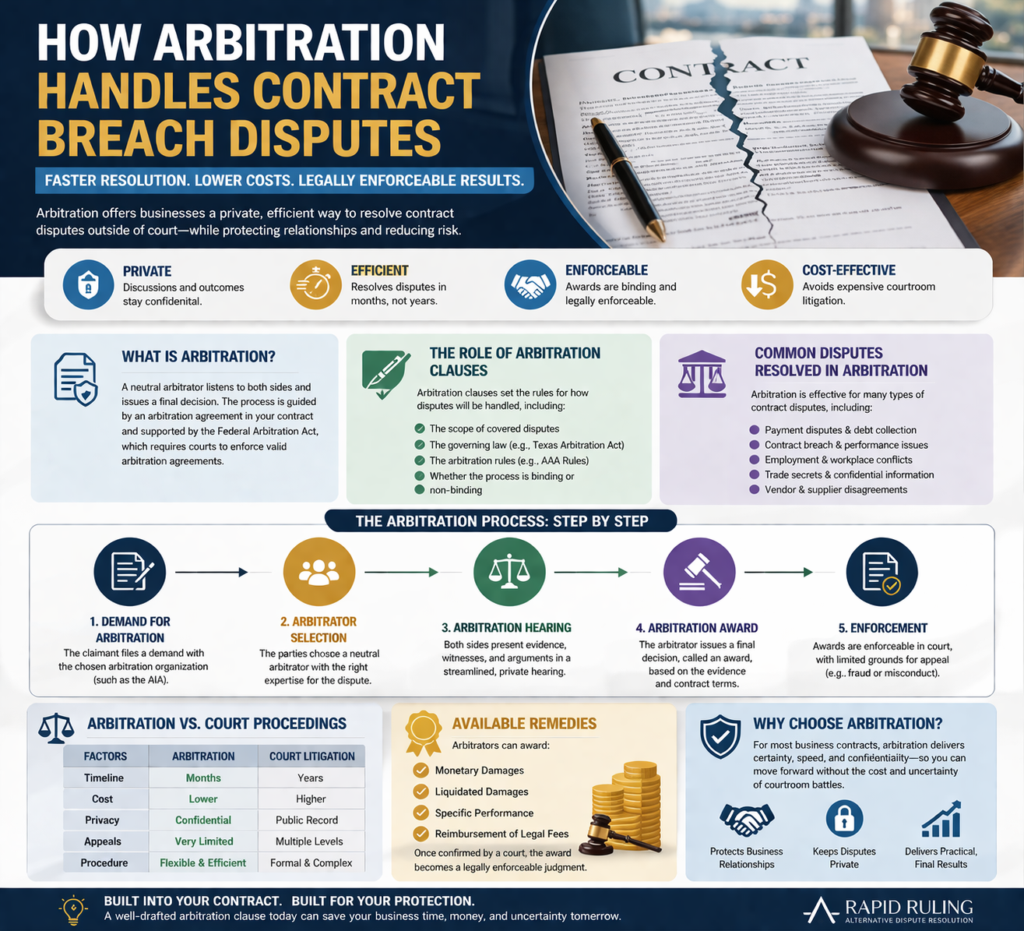
Arbitration is a private dispute-resolution mechanism where a Neutral Third Party decides contractual disputes outside a traditional court of law. It is typically triggered by arbitration clauses or a dispute resolution clause in business contracts or a user agreement.
The legal foundation for enforcing arbitration agreements comes from the Federal Arbitration Act.
This federal statute requires courts to enforce valid arbitration agreements and limits unnecessary courtroom interference.
The U.S. Supreme Court has repeatedly reinforced this policy. In cases involving Coinbase Inc. the Court clarified that when an arbitration agreement exists, courts must respect that contractual choice while threshold issues are resolved.
The Role of Arbitration Clauses in Business Contracts
Why Arbitration Agreements Matter
An arbitration clause defines how contract dispute resolution will occur. Many agreements incorporate the Commercial Arbitration Rules of the American Arbitration Association which provide procedural structure for arbitration claims, arbitrator selection, and arbitration hearings.
The American Arbitration Association (AAA) is one of the most widely used arbitration organizations in commercial matters.
Clear drafting skills during contract negotiation are essential. A well structured arbitration agreement should identify:
- Whether the process is Binding Arbitration or Non-Binding Arbitration
- The governing law, such as the Texas Arbitration Act.
- The scope of disputes covered, including Payment disputes, Liquidated Damages, and Specific Performance
Poorly drafted ADR clauses often result in preliminary litigation before a district court simply to determine enforceability.
The Arbitration Process Step by Step
Filing a Demand for Arbitration
The arbitration process begins when a party submits a Demand for Arbitration to the selected arbitration organization. The AAA provides administrative case management and scheduling oversight.
Arbitration Hearing
An arbitration hearing resembles streamlined court proceedings but without full courtroom litigation formalities. Legal counsel presents evidence related to contract breach claims, contractual disputes, or business transactions.
Employment matters often proceed under the AAA Employment/Workplace Arbitration Rules which establish fairness standards for workplace disputes.
Arbitration Awards and Final Decision
After reviewing evidence, the arbitrator issues arbitration awards. These arbitral awards are typically binding and enforceable. Judicial review is limited to narrow issues such as fraud or misconduct.
Guidance from the Federal Judicial Center on Alternative Dispute Resolution in Federal Courts explains how federal courts handle confirmation and limited review of arbitration awards.
Arbitration vs Court Proceedings
Business owners frequently ask whether arbitration is better than filing in small claims court or Business Court. The answer depends on the dispute-resolution mechanisms built into your contract. State courts, including California courts through their ADR programs actively promote dispute resolution outside traditional trials to reduce backlog and improve efficiency.
Common Contract Disputes Resolved Through Arbitration
Arbitration frequently addresses:
- Payment disputes and debt collections
- Contract breach claims involving international vendors
- Employment disputes
- Trade secrets and confidential business transactions
- Mass arbitration related to consumer user agreement claims
In industries such as cryptocurrency exchange platforms or international case matters, arbitration protects confidentiality while offering enforceable remedies.
Remedies and Enforcement
Arbitrators may award:
- Monetary damages
- Liquidated Damages
- Specific Performance
- Allocation of legal bills
Once confirmed by a court of law, arbitration awards become enforceable judgment debts.
The limited appeals process reinforces finality. Courts generally defer to arbitral awards unless there is clear statutory violation under the Federal Arbitration Act.
Is Arbitration Right for Your Contract Dispute
Not every matter can be arbitrated. Certain statutory claims and criminal issues require court oversight. However, for most business contracts, arbitration offers efficiency, privacy, and enforceability.
When drafting arbitration clauses, consult experienced legal counsel to ensure alignment with your contract law principles and long-term business strategy.
How Rapid Ruling Supports Contract Arbitration
At Rapid Ruling, we assist clients navigating Contract disputes through structured arbitration processes that prioritize clarity and enforceable outcomes. Whether addressing Payment disputes, enforcing arbitration awards, or managing cross-border contractual relationships, our approach is grounded in proven dispute-resolution mechanisms.
A contract breach does not have to end in prolonged courtroom litigation. With a properly drafted arbitration agreement and strategic guidance, arbitration can deliver a practical, legally sound final decision that protects your business relationships and financial stability.
Recent Posts

Arbitration is widely used to resolve disputes outside of traditional courtrooms. While it offers speed and confidentiality, parties often wonder if an arbitrator’s award can ever be overturned. Understanding the legal framework, judicial review standards, and practical challenges is essential for anyone

What Happens When One Party Refuses to Participate in Arbitration
Arbitration is often touted as a faster, more efficient alternative to traditional court litigation. Yet, even with a clear arbitration agreement in place, disputes can stall when one party simply refuses to participate. I’ve seen this firsthand working with businesses navigating complex dispute resolution

How Arbitration Awards Are Enforced in State and Federal Courts
Arbitration awards can resolve disputes efficiently, but their enforceability depends on navigating complex federal and state procedures. Whether a business is enforcing a domestic award in a U.S. federal court or an international arbitral award under the New

How Arbitration Handles Contract Breach Disputes
A business owner in Atlanta Georgia once shared that a failed supplier agreement nearly pushed his company into courtroom litigation. The disagreement started as a simple Quality of goods/services issue but escalated into formal court proceedings and

What Is an Arbitration Agreement?
If you’ve ever signed a cell phone contract, started a new job, or signed paperwork for a gym membership in places like Long Island, Manhattan, or Queens, chances are you agreed to something you barely noticed in the fine print: an arbitration agreement. Most